| ⭐ Trust Signals at a Glance EPA Lead Safe Certified Firm, Required for homes built before 1978 A+ Rating with Better Business Bureau (BBB) 3-Year Workmanship Warranty on all completed projects Proprietary app-based communication — real-time updates for every project Serving Bergen, Union, Passaic, Essex, Morris & Somerset Counties Free virtual and in-home consultations available |
1. Why New Jersey Homeowners Are Remodeling Their Bathrooms in 2026
New Jersey has one of the most competitive real estate markets in the entire country. From the leafy suburbs of Bergen County to the historic downtown districts of Morristown and Montclair, homes here are scrutinized by buyers, neighbors, and Zillow algorithms alike.
And yet — bathrooms remain the most neglected room in most NJ homes.
That is not an opinion. Walk through any open house in Summit, Westfield, or Ridgewood and you will find outdated tile work, cramped layouts, and fixtures that have not been touched since the 1990s. Meanwhile, the same homes have freshly painted walls, updated kitchens, and professionally landscaped yards.
Here is the reality: a well-executed bathroom remodel NJ project delivers some of the highest return on investment of any home improvement project you can make. It improves your daily quality of life immediately. It positions your home to sell faster and at a higher price. And in 2026, with North Jersey buyer expectations at an all-time high, an outdated bathroom is an active liability.
This guide is written specifically for New Jersey homeowners. Not generic renovation advice — real NJ permit requirements, real NJ contractor vetting guidance, county-specific insights, and honest cost breakdowns based on what projects in Bergen County, Essex County, Morris County, Union County, and beyond actually cost in 2026.
About the Author: Paul is the owner of The Powder Room Guys, a New Jersey bathroom renovation specialist serving over 70 NJ communities across 6 counties. The Powder Room Guys are EPA Lead Safe Certified, A+ Rated with the Better Business Bureau, and have delivered hundreds of bathroom renovations across North and Central Jersey — each backed by a 3-year workmanship warranty.
2. Understanding NJ Building Codes & Permits (County-by-County)
This is the section that separates experienced NJ bathroom contractors from the ones who cut corners. New Jersey has a comprehensive Uniform Construction Code (NJ UCC) that governs all residential renovation work — and every county enforces it through its own Construction Office.
Ignoring permits is not just illegal — it is expensive. Unpermitted work discovered during a home sale can delay or kill the transaction entirely. It voids your homeowner’s insurance for related claims. And it means the work has never been inspected for safety compliance.
2.1 When Do You Need a Permit for a Bathroom Remodel in NJ?
Under the New Jersey Uniform Construction Code (N.J.A.C. 5:23), the following generally require permits:
- Plumbing permit required: Any new rough-in work, moving drain lines, replacing supply lines, adding fixtures, or changing hot water heater locations. Filed with the Municipal Plumbing Subcode Official.
- Electrical permit required: Any new circuits, panel upgrades, GFCI installation, adding outlets or lighting, exhaust fan installation. All bathroom electrical work in NJ must comply with the NEC (National Electrical Code) as adopted by NJ.
- Building permit required: Any structural changes — removing walls, widening doorways, adding skylights, changing floor joists. Also required for room additions.
- No permit required (typically): Like-for-like fixture replacements in the exact same location, cosmetic work (paint, accessories, mirror replacement), re-caulking.
2.2 County-by-County Permit Process
| County | Permit Office | Typical Turnaround | Key Notes |
| Bergen County | Municipal Construction Office | 2–4 weeks | Each of Bergen’s 70 municipalities issues its own permits — apply to your specific town |
| Essex County | Municipal level varies | 2–5 weeks | Newark, Montclair, South Orange have most active construction offices |
| Morris County | Municipal Construction Office | 2–4 weeks | Morristown, Madison, Summit (Union) have strict historic district review |
| Union County | Municipal level | 2–3 weeks | Summit, Westfield, Scotch Plains — all require separate municipal permits |
| Passaic County | Municipal level | 2–4 weeks | Wayne, Clifton, Totowa most active permit municipalities |
| Somerset County | Municipal level | 2–3 weeks | Warren Township, Watchung — typically faster turnaround |
| ⚠️ Critical NJ Permit Warning Never hire a NJ bathroom contractor who says ‘we don’t need permits for this’ when plumbing or electrical work is involved — this is a major red flag. All licensed NJ plumbing and electrical contractors are required by law to pull their own permits. If your contractor asks YOU to pull permits, that is another red flag — licensed tradespeople pull their own. Permit fees in NJ typically run $150–$600 for bathroom renovations depending on municipality and scope. |
3. Complete Cost Breakdown for NJ Bathroom Remodels (2026)
Let us talk real numbers. The cost ranges below are based on actual project data from North and Central New Jersey — not national averages that have no relationship to what plumbers and tile contractors actually charge in Bergen County.
3.1 Cost by Bathroom Size
| Bathroom Size | Cosmetic Refresh | Full Remodel | Luxury Renovation | Typical Duration |
| Small (50–75 sq ft) | $4,000–$8,000 | $8,000–$15,000 | $15,000–$25,000 | 1–2 weeks |
| Medium (75–100 sq ft) | $7,000–$12,000 | $15,000–$25,000 | $25,000–$40,000 | 2–3 weeks |
| Master (100–150 sq ft) | $12,000–$20,000 | $25,000–$45,000 | $45,000–$70,000 | 3–5 weeks |
| Luxury (150+ sq ft) | $18,000–$30,000 | $45,000–$65,000 | $65,000–$100,000+ | 5–8 weeks |
* Prices reflect North Jersey market rates (Bergen, Morris, Union, Essex Counties). Somerset and Passaic County projects typically run 8–12% lower.
3.2 What Drives NJ Bathroom Remodel Costs Up
Understanding these cost drivers lets you have an honest conversation with your contractor and make informed trade-offs:
- Moving plumbing: +$2,000–$6,000. The single biggest avoidable cost. If you can keep the toilet, shower, and vanity in the same location, do it.
- Asbestos abatement: +$800–$5,000. Homes built before 1980 in NJ frequently have asbestos floor tiles, pipe insulation, or drywall compound. EPA-certified firms like The Powder Room Guys handle this safely and legally.
- Lead paint remediation: +$500–$3,500. Required by federal law (EPA RRP Rule) in homes built before 1978. Only EPA Lead Safe Certified firms can legally do this work. Always verify certification.
- Structural wall removal: +$1,500–$5,000. Requires a building permit, structural engineer sign-off in most NJ municipalities, and additional time.
- Custom tile work: +$1,000–$8,000 premium over standard tiling. Large-format tiles (24×48+), intricate mosaic patterns, or natural stone all cost significantly more in labor.
- High-end imported fixtures: European brands (Hansgrohe, AXOR, Duravit, Villeroy & Boch) popular in Summit and Short Hills — add $2,000–$15,000 over domestic equivalents.
3.3 Material Cost Breakdown
| Material Item | Budget Tier | Mid-Range | Luxury |
| Floor tiles (per sq ft installed) | $8–$18 | $18–$45 | $45–$120+ |
| Wall tiles (per sq ft installed) | $6–$15 | $15–$40 | $40–$100+ |
| Walk-in shower system | $600–$1,400 | $1,400–$4,500 | $4,500–$15,000 |
| Freestanding / soaking tub | $400–$1,200 | $1,200–$4,000 | $4,000–$12,000 |
| Toilet (elongated, comfort height) | $200–$500 | $500–$1,500 | $1,500–$5,000 |
| Vanity + countertop (single) | $400–$1,200 | $1,200–$4,000 | $4,000–$12,000 |
| Double vanity (master bath) | $800–$2,000 | $2,000–$6,000 | $6,000–$18,000 |
| Shower fixtures / valve | $200–$600 | $600–$2,000 | $2,000–$8,000 |
| Lighting package | $200–$600 | $600–$2,000 | $2,000–$6,000 |
| Heated floor system | N/A | $800–$2,500 | $2,500–$6,000 |
| Exhaust fan (code required) | $100–$300 | $300–$800 | $800–$2,000 |
| Mirror / medicine cabinet | $100–$400 | $400–$1,200 | $1,200–$4,000 |
3.4 Labor Costs in North Jersey (2026)
| Trade | Hourly Rate (NJ) | Typical Project Cost | Licensing Requirement |
| Licensed plumber | $95–$145/hr | $1,800–$6,000 | NJ Master Plumber license |
| Licensed electrician | $85–$130/hr | $800–$3,500 | NJ Master Electrician license |
| Tile installer | $65–$100/hr | $1,200–$5,000 | No license req., but verify experience |
| General contractor | $75–$115/hr | $3,000–$10,000 | NJ Home Improvement Contractor reg. |
| Carpenter / finish work | $65–$95/hr | $600–$3,000 | No license req. |
| Painter | $55–$80/hr | $400–$1,200 | No license req. |
| 💡 NJ Labor Law: What Every Homeowner Must Know All NJ Home Improvement Contractors must be registered with the NJ Division of Consumer Affairs (NJ HIC registration). Verify at: njconsumeraffairs.gov Plumbers and electricians in NJ must hold a valid state license. Always ask for license number and verify at: nj.gov/cgi-bin/consumer/licenseinfo Working ‘off the books’ (cash, no permits) means zero legal protection if work fails — and possible penalties for the homeowner at sale time. The Powder Room Guys are fully NJ HIC registered, EPA Lead Safe Certified, and all subcontractors are licensed and insured. |
4. How to Choose a Bathroom Contractor in NJ — Questions, Red Flags & Verification
In North Jersey’s competitive renovation market, the gap between the best and worst bathroom contractors is enormous — and the stakes are high. A bad contractor can leave you with unpermitted work, failed inspections, leaks hidden behind new tile, or a legal dispute that costs more than the renovation itself.
Here is exactly what to look for, what to ask, and what should send you walking away immediately.
4.1 The Non-Negotiable Verification Checklist
- NJ HIC Registration: Every contractor doing home improvement work in NJ must be registered. Verify at njconsumeraffairs.gov. No registration = do not hire.
- General liability insurance: Minimum $1M per occurrence. Ask for a Certificate of Insurance naming you as additionally insured for the project.
- Workers’ compensation insurance: If the contractor has employees, NJ law requires Workers’ Comp. Without it, you could be liable if a worker is injured on your property.
- EPA Lead Safe Certification: For homes built before 1978, required by federal law. The Powder Room Guys are EPA Lead Safe Certified — verify any contractor’s certification at cfpub.epa.gov/flpp/pub/index.cfm?do=main.firmSearch
- BBB Rating: While not a guarantee of quality, an A+ BBB rating with no unresolved complaints is a strong positive signal. The Powder Room Guys maintain an A+ BBB rating.
- Licensed plumbing and electrical subs: Ask specifically which plumber and electrician they use and verify their NJ licenses independently.
4.2 Eight Questions to Ask Every NJ Contractor
- Can I see your NJ HIC registration number and certificate of insurance right now?
- Are you EPA Lead Safe Certified? (Critical for pre-1978 NJ homes)
- Will you pull all required permits — plumbing, electrical, and building?
- Can you provide three references from completed bathroom projects in my county in the past 12 months?
- What is your exact payment schedule? (Correct answer: milestone-based, never more than 30% upfront)
- Who specifically does your plumbing and electrical work? What are their NJ license numbers?
- What warranty do you provide on workmanship? (The Powder Room Guys provide 3 years)
- How do you handle communication during the project? (Ask about their specific process — The Powder Room Guys use a dedicated app with daily photo updates)
4.3 Red Flags — Walk Away Immediately If You See These
| Red Flag | Why It Matters | Risk Level |
| No NJ HIC registration | Illegal to do home improvement work in NJ without it | EXTREME |
| Requests over 30% upfront deposit | Industry standard is 10–30% max before work starts | HIGH |
| Suggests skipping permits | Unpermitted work is your legal liability at sale time | HIGH |
| Significantly lower than all other quotes | Usually means unlicensed subs, cheap materials, or missing scope | HIGH |
| Cannot provide written contract | No written contract = no legal protection for either party | HIGH |
| Vague about who does plumbing/electrical | May be using unlicensed workers for code-required trades | HIGH |
| No EPA certification for pre-1978 homes | Violation of federal RRP Rule; health and legal risk | HIGH |
| Pressure to decide today / price expires | High-pressure sales tactic — reputable contractors don’t do this | MEDIUM |
| No physical NJ business address | Out-of-state or fly-by-night — no accountability if things go wrong | MEDIUM |
| “I am so happy we reached out to The Powder Room Guys after receiving an offensively high quote from another contractor. Paul communicated clearly and was completely transparent about every step. His workers notified us when they would arrive each morning and posted pictures of their progress at the end of the day.” — Tiffany Lin | Morris County |
5. NJ-Specific Considerations Every Homeowner Must Know
5.1 Lead Paint Regulations — EPA RRP Rule
This is one of the most important — and most frequently ignored — aspects of bathroom renovation in New Jersey’s older housing stock. If your home was built before 1978, federal law (EPA Renovation, Repair and Painting Rule / RRP Rule) requires that all renovation work that disturbs painted surfaces must be performed by an EPA Lead-Safe Certified Firm using certified renovators.
This is not optional. It is federal law. Violations carry fines up to $37,500 per day per violation.
What this means practically for your NJ bathroom remodel:
- Your contractor must be EPA Lead Safe Certified — not just ‘lead aware’ or ‘trained in lead safety.’ Certified. Verify the certification.
- The certified renovator must use specific containment and work practice procedures during demolition.
- Post-renovation cleaning verification and documentation is required.
- The Powder Room Guys are an EPA Lead Safe Certified Firm — this is one of the reasons homeowners in older NJ towns (Montclair, Summit, Morristown, Glen Ridge, South Orange) specifically seek them out.
| 🏠 Which NJ Towns Are Most Affected by Lead Paint Requirements? Highest proportion of pre-1978 homes in our service area include: Montclair, Glen Ridge, South Orange, Maplewood, Summit, Morristown, Madison, Chatham, Westfield, Cranford, Bloomfield, Nutley, East Orange If you live in any of these communities and your home was built before 1978, insist on EPA Lead Safe Certification verification before signing any contract. |
5.2 Historic Home Considerations
North Jersey has some of the most beautiful historic housing stock in the entire United States — and some of the most complex regulatory environments for renovation work.
- Summit, NJ: The City of Summit has a Historic Preservation Commission that reviews exterior changes to properties in historic districts. Interior bathroom renovations generally do not require HPC review, but verify if your property is on the local or National Register of Historic Places.
- Morristown, NJ: The Morristown Historic District encompasses significant portions of the residential neighborhoods. The Historic Preservation Office should be consulted for any exterior penetrations (new windows, skylights) even for bathroom projects.
- Montclair, NJ: Montclair has an active Historic Preservation Commission. Many of the town’s Victorian and Craftsman-era homes have architectural features that require careful, reversible renovation approaches.
- Glen Ridge, NJ: A predominantly historic borough with strong community emphasis on preservation. While interior renovations are generally not reviewed, significant structural changes may attract scrutiny.
Working with a contractor experienced in NJ historic homes — like The Powder Room Guys, who work extensively across these communities — makes the difference between a smooth approval process and costly surprises.
5.3 HOA and Condo Rules in Bergen County
Bergen County has a significant condominium and planned community population, particularly in towns like Fort Lee, Edgewater, Hackensack, Paramus, and Ridgefield. Before starting any bathroom renovation in a condo or HOA community:
- Review your association’s Declaration of Covenants, Conditions & Restrictions (CC&Rs) for renovation restrictions
- Check whether your HOA requires pre-approval for any renovation work — most do
- Confirm approved working hours — many Bergen County condo boards restrict contractor hours to 8am–5pm weekdays
- Verify noise ordinance requirements for your municipality — some towns prohibit demolition before 8am or after 5pm
- Ask whether your building has a requirement to use union labor or building-approved contractors
- Confirm wet wall waterproofing requirements — some associations require specific products or third-party inspection
6. Realistic Timeline for a NJ Bathroom Renovation (2026)
One of the most common sources of frustration in bathroom remodeling NJ projects is unrealistic timeline expectations set by over-eager contractors. Here is a genuinely accurate schedule — based on real Powder Room Guys project data — for a full bathroom renovation in New Jersey:
| Phase | Duration | What Happens | Who Is Involved |
| Initial consultation | 1–2 hours | Scope discussion, preliminary pricing, design direction | Paul / Project Lead |
| Detailed proposal & design | 3–7 days | Itemized scope, material selections, floor plan review | Paul + design team |
| Contract signing | 1–2 days | Contract review, deposit payment, project scheduled | Homeowner + contractor |
| Permit application | 1–5 weeks | Plumbing, electrical, building permits filed with municipality | Licensed subs |
| Material procurement | 1–4 weeks | Tiles, fixtures, vanity ordered — custom items take longer | Contractor + homeowner |
| Demolition | 1–2 days | Controlled removal of existing tile, fixtures, drywall | Demo crew |
| Rough plumbing | 1–3 days | New drain lines, supply lines, shower valve rough-in | Licensed NJ plumber |
| Rough electrical | 1–2 days | New circuits, GFCI outlets, exhaust fan wiring | Licensed NJ electrician |
| Inspection #1 | 1–3 days | Municipal rough-in inspection for plumbing & electrical | Municipal inspector |
| Waterproofing | 1–2 days | Schluter, RedGard, or similar system — requires cure time | Tile contractor |
| Backer board / substrate | 1 day | Cement board installation for tile surfaces | Tile contractor |
| Tile work (floor & walls) | 3–7 days | Depends heavily on pattern complexity and area | Tile contractor |
| Fixture installation | 2–3 days | Vanity, toilet, shower, lighting, mirrors, accessories | Plumber + carpenter |
| Finish electrical | 1 day | Outlets, switches, exhaust fan final connection | Licensed NJ electrician |
| Grout, caulk, sealant | 1–2 days | Includes cure time for silicone and sealants | Tile contractor |
| Final inspection | 1–3 days | Municipal final inspection for all permitted work | Municipal inspector |
| Punch list & final clean | 0.5–1 day | Touch-ups, professional cleaning, walkthrough with Paul | Project Lead |
Total realistic project duration (full remodel): 6–14 weeks from first contact to completed project.
Actual on-site working time: 12–20 working days. The calendar time is longer due to permit processing, material lead times, and inspection scheduling.
| 📱 How The Powder Room Guys Handle Communication During Your Project Every Powder Room Guys project uses a dedicated project management app for real-time communication. You, the project lead, all licensed subcontractors, and material vendors communicate in one place. You receive daily photo updates showing progress at end of each workday. No ‘he said / she said’ — every decision and change is documented in writing. Direct access to Paul and the project team at any time during business hours. One homeowner worked with us remotely from vacation and said: ‘We received daily updates and could reach out to any of the vendors or contractors at any time. It went without a hitch.’ |
7. Bathroom Design Trends Popular in New Jersey (2026)
New Jersey homeowners have always had access to New York City’s design culture — and it shows. The 2026 NJ bathroom design landscape is sophisticated, influenced by both Manhattan luxury aesthetics and the practical needs of family homes in the suburbs.
7.1 Large-Format Tile Dominates
The 12×12 tile that defined NJ bathrooms for two decades is gone. The dominant tile format in 2026 is 24×48 rectified porcelain — dramatic, clean-lined, and visually expanding for NJ bathrooms that often run under 100 square feet. Continuous floor-to-ceiling applications with minimal grout lines are the hallmark of premium NJ renovations this year.
7.2 Curbless Walk-In Showers
The barrier-free, curbless walk-in shower has fully crossed over from luxury-only to standard expectation in North Jersey master bathrooms. Linear floor drains, seamless glass panels, and rainfall showerheads create spa-like experiences that age-in-place advocates and design-forward homeowners both love. In our Bergen County and Union County projects, curbless showers now appear in more than 70% of master bathroom renovations.
7.3 Warm Neutrals Replace Cold White
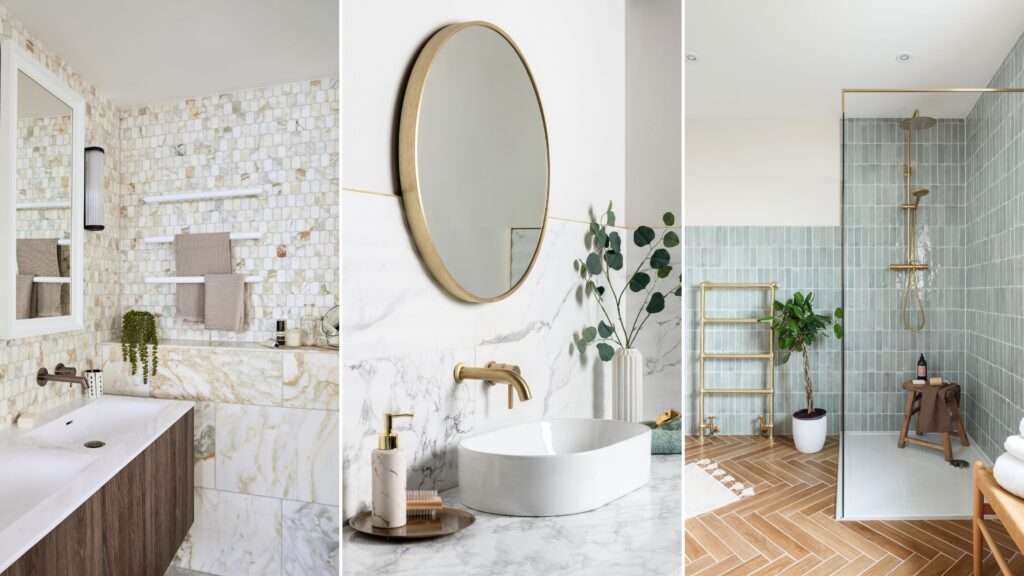
After a decade of bright white subway tile and chrome fixtures, NJ homeowners are decisively moving toward warmer palettes: warm greige walls, terracotta and clay-toned tiles, matte black or brushed brass fixtures, and wood-grain vanities. The ‘spa bathroom’ aesthetic — once confined to luxury projects in Short Hills and Ridgewood — has become the dominant aesthetic request across all price points.
7.4 Double Vanities as Standard
In any bathroom over 75 square feet that serves two people, NJ homeowners in 2026 overwhelmingly request double vanities. It is consistently cited as the single feature that most improves daily quality of life. If your bathroom has the footprint for it and you are not including a double vanity in your renovation plan, talk to your contractor about making it work.
7.5 Smart Bathroom Technology
Smart exhaust fans with humidity sensors (Panasonic WhisperSense is enormously popular in NJ projects), digital shower controls, heated mirrors with integrated LED and demisting, and in higher-end projects, voice-controlled lighting via Google Home or Amazon Alexa are all appearing regularly in 2026 NJ renovations.
7.6 Accessibility-Forward Design
New Jersey’s aging homeowner population — particularly in Morris and Somerset Counties — is driving significant demand for accessibility-integrated design: comfort-height toilets, curbless showers with fold-down teak benches, grab bars integrated elegantly into tile patterns (not the clinical-looking afterthoughts), and wider doorways. A good NJ bathroom contractor should be designing for the long term, not just for current occupant ages.
| “Paul is a diamond in the rough — thoughtful, consultative, fair and regimented. Working with him and his team is seamless and painless with beautiful results. None of the many contractors I’ve worked with during my phased remodel come close to The Powder Room Guys experience — and most quoted me far more for my project.” — Samira Nejad | Essex County |
8. Financing Options for NJ Homeowners
A full bathroom remodel NJ project is a significant investment. The good news is that New Jersey homeowners have access to a strong range of financing options — including some state-specific programs that many homeowners completely overlook.
8.1 New Jersey State Incentive Programs
- New Jersey Clean Energy Program: For bathroom renovations that include energy-efficient upgrades (Energy Star exhaust fans, efficient water heaters, LED lighting), NJ BPU offers rebates. Check njcleanenergy.com for current incentive schedules.
- NJ Division of Taxation Home Improvement Sales Tax: Renovation labor in NJ is NOT subject to sales tax. Only materials are taxed. Make sure your contractor invoices clearly separate labor from materials — improperly structured invoices can cost you money.
- NJ Housing and Mortgage Finance Agency (HMFA): The NJHMFA offers renovation-specific financing products for qualified homeowners. Visit njhousing.gov for current programs.
- Historic preservation grants: Homeowners with properties on the State or National Register of Historic Places may qualify for NJ Historic Trust grants for qualifying preservation work.
8.2 Standard Financing Products
- Home Equity Line of Credit (HELOC): With North Jersey property values strong in 2026, many homeowners have significant equity. HELOCs offer flexible access to funds at relatively low rates — typically prime + 0–2%.
- Cash-out mortgage refinance: For larger projects ($40,000+), refinancing to pull equity can make sense if current rates are favorable.
- Personal renovation loan: Unsecured personal loans from lenders like LightStream, SoFi, or Marcus offer 6–15% APR for renovation purposes — quick approval, no collateral required.
- Contractor financing programs: Many NJ contractors partner with GreenSky, Synchrony, or Hearth financing. Ask The Powder Room Guys about available financing options at time of consultation.
8.3 Payment Schedule — What to Expect and Demand
A standard, legitimate NJ bathroom contractor payment schedule looks like this:
| Milestone | Typical Payment % | Why This Milestone |
| Contract signing / deposit | 10–25% | Secures your spot on schedule, covers initial material deposits |
| Demolition complete / rough-in started | 25–35% | Confirms project is underway, covers material procurement |
| Tile work complete | 25–35% | Major visible milestone — you can see the transformation |
| Final completion / punch list done | 15–25% | Never pay this until YOU are satisfied with everything |
| 🚨 Payment Red Flags for NJ Homeowners Never pay more than 30% upfront before any work begins. Never pay the final installment until your punch list is 100% complete and you have the Certificate of Occupancy (if a CO was required for your permit). Cash-only payment requests with no receipts or contract? Walk away — this is a tax fraud scheme that leaves you with zero legal protection. The Powder Room Guys provide a fully itemized contract with milestone-based payment schedule on every project. |
9. County-Specific Insights: Bergen, Essex, Morris, Union, Passaic & Somerset
9.1 Bergen County Bathroom Remodeling
Bergen County is the most affluent and most competitive renovation market in New Jersey. With 70 municipalities ranging from dense urban centers like Hackensack to wealthy suburbs like Ridgewood and Tenafly, Bergen County homeowners expect the highest quality workmanship and the most sophisticated design sensibilities.
Key Bergen County Facts: Labor rates run 15–20% above state average. HOA regulations are extensive in condo-dense towns like Fort Lee and Edgewater. Pre-permit historic review required in some Ridgewood and Westwood properties.
Popular Towns We Serve: Paramus, Hackensack, Teaneck, Fair Lawn, Ridgefield, River Edge, Rochelle Park, Leonia, Tenafly, Glen Rock, Englewood Cliffs.
Typical Full Bathroom Remodel Range: $20,000 – $40,000 for medium bathroom.
9.2 Essex County Bathroom Remodeling
Essex County contains some of New Jersey’s most architecturally significant residential housing — the Victorian Painted Ladies of Montclair, the Craftsman bungalows of Glen Ridge, the Georgian colonials of South Orange. Bathroom renovation here demands respect for original architectural character combined with modern functionality.
Key Essex County Facts: Strong historic preservation culture in Montclair, Glen Ridge, Maplewood, South Orange, Verona. Very high proportion of pre-1978 homes requiring EPA Lead Safe certified contractors. Active local building departments in most towns.
Popular Towns We Serve: Montclair, Glen Ridge, South Orange, Maplewood, Bloomfield, Nutley, Livingston, Millburn, West Orange, Caldwell, North Caldwell.
Typical Full Bathroom Remodel Range: $17,000 – $35,000 for medium bathroom.
9.3 Morris County Bathroom Remodeling
Morris County’s charming small-town character — from the colonial streetscapes of Madison and Chatham to the historic center of Morristown — makes it one of the most desirable places to live in New Jersey. Bathroom renovation here tends to blend traditional design sensibilities with contemporary function.
Key Morris County Facts: Morristown Historic District has specific review requirements. Madison and Chatham Borough have active construction offices. Mountain Lakes and Morris Plains have more permissive renovation environments.
Popular Towns We Serve: Morris Plains, Morristown, Morris Township, Madison, Chatham, Florham Park, East Hanover, Hanover Township, Mountain Lakes, Parsippany-Troy Hills.
Typical Full Bathroom Remodel Range: $16,000 – $32,000 for medium bathroom.
9.4 Union County Bathroom Remodeling
Union County contains some of the most prestigious addresses in North Jersey — Summit’s Country Club neighborhood, Westfield’s tree-lined historic district, and Scotch Plains’ gracious estate homes. Homeowners here demand quality and attention to detail that matches their home’s character.
Key Union County Facts: Summit has both a Historic Preservation Commission and one of the most rigorous municipal building departments in the state. Westfield and Scotch Plains have very active permit offices. Clark and Cranford have strong community character with preservation awareness.
Popular Towns We Serve: Summit, Westfield, Scotch Plains, Cranford, Clark, Fanwood, Garwood, Mountainside, New Providence, Springfield, Union, Watchung.
Typical Full Bathroom Remodel Range: $19,000 – $38,000 for medium bathroom.
9.5 Passaic & Somerset Counties
Passaic County: Wayne, Clifton, Totowa, and North Haledon are our primary Passaic County service communities. Dense suburban character with strong value orientation — homeowners here prioritize durability and functionality. Average full remodel: $15,000 – $28,000.
Somerset County: Warren Township, Watchung, and the broader Somerset Hills area combine country-property scale with North Jersey sophistication. Larger homes often mean larger bathrooms and higher renovation scopes. Average full remodel: $16,000 – $30,000.
| “If you are thinking about hiring the Powder Room Guys, please do it! My family and I are SO happy with our bathroom. Paul and his team were detailed, thorough, and professional — our renovation plan was pages long. I should add that my husband and I were away on vacation while the entire renovation took place and it went without a hitch. We received daily updates and could reach out to any of the vendors or contractors at any time.” — Mecca Lewis | Bergen County |
10. ROI for Bathroom Remodels in North & Central New Jersey
Let us talk about the financial reality of bathroom renovation as a home investment in the NJ market — not national statistics, but North Jersey real estate data.
10.1 Return on Investment by Project Type (NJ Data)
| Renovation Type | Average Cost | Avg. Value Added | ROI % | Impact on Days on Market |
| Cosmetic refresh (fixtures, tile) | $6,500 | $8,500 | 130% | Reduces by ~2–3 weeks |
| Full mid-range bathroom remodel | $20,000 | $24,000 | 120% | Reduces by ~3–5 weeks |
| Adding en-suite to master bedroom | $18,000 | $28,000 | 155% | Reduces by ~4–6 weeks |
| Luxury master bath renovation | $45,000 | $45,000 | 100% | Strong buyer appeal, faster offers |
| Converting tub to walk-in shower | $8,000 | $11,200 | 140% | Significant appeal to 35–65 yr buyers |
Key North Jersey market insight: In Bergen County, Essex County, and Union County, an updated bathroom is the #2 most-cited factor in buyer purchase decisions (after kitchen condition). An outdated bathroom in a Summit, Westfield, or Ridgewood home actively reduces sale price by 4–8% and adds an average of 3–6 weeks to time on market.
Adding an en-suite bathroom to a North Jersey home that currently has only one full bath delivers the highest ROI of any single renovation project — consistently and significantly outperforming kitchen renovations in terms of return.
10.2 The Powder Room Guys’ Approach to ROI-Focused Renovations
Not every renovation dollar delivers equal return. When homeowners work with Paul and The Powder Room Guys, one of the first conversations is about investment objectives — whether you are renovating to improve your own quality of life and plan to stay for 10+ years, or whether you are renovating to sell within 2–3 years. Both are valid, and both call for different material and scope decisions.
Renovating to enjoy and stay: Prioritize personal comfort — heated floors, luxury fixtures, exactly the design you love. ROI matters less than daily quality of life improvement.
Renovating to sell within 2–3 years: Prioritize broad buyer appeal — neutral palettes, quality materials without bespoke quirks, walk-in shower, double vanity if possible. Focus spend on features buyers in your specific town consistently request.
Frequently Asked Questions: Bathroom Remodeling New Jersey
| Note for Web Developer: Implement all Q&As below as FAQPage schema markup |
How long does a bathroom remodel take in NJ?
A full bathroom renovation NJ project takes 12–20 working days on-site. Including planning, permits, and material procurement, the total timeline from first contact to completed project is typically 6–14 weeks. Permit processing time (1–5 weeks depending on municipality) is the most variable element.
Do I need a permit for bathroom remodel in New Jersey?
Any bathroom renovation in NJ involving plumbing changes, electrical work, or structural modifications requires permits from your municipal Construction Office. Cosmetic work (paint, accessories, fixture replacement in the same location) typically does not. The Powder Room Guys handle all permit applications as part of the project.
What is the average bathroom remodel cost in NJ?
The North Jersey average for a full bathroom renovation is $18,000–$28,000 for a medium-sized bathroom (75–100 sq ft). Small bathrooms start from $8,000–$15,000. Master bathroom renovations range from $25,000–$45,000. Bergen County and Union County projects typically run 15–20% above these figures.
Do NJ contractors need to be EPA certified?
For any home built before 1978, yes — federal EPA RRP Rule requires all contractors disturbing painted surfaces to be EPA Lead Safe Certified Firms using certified renovators. The Powder Room Guys are fully EPA Lead Safe Certified. Always verify any contractor’s certification before signing a contract for work on an older NJ home.
What warranty should I expect from a NJ bathroom contractor?
New Jersey home improvement law requires contractors to clearly state their warranty terms in writing. Quality contractors provide at least 1 year on workmanship; The Powder Room Guys provide a 3-year workmanship warranty — significantly above the NJ norm — because Paul believes in standing behind every project long-term.
How do I verify a NJ contractor’s license and registration?
Verify NJ Home Improvement Contractor (HIC) registration at njconsumeraffairs.gov/hic. Verify plumber license at nj.gov/cgi-bin/consumer/licenseinfo. Verify electrician license at the same NJ licensing portal. Always verify independently — do not just trust the number a contractor gives you.
Can I do a bathroom remodel myself in NJ?
Cosmetic work (painting, accessories, fixture replacement) is DIY-friendly. However, plumbing and electrical work in NJ must be permitted and inspected — and while homeowners can technically do their own plumbing work, it requires a permit and must pass municipal inspection. Electrical work above simple fixture replacement should be done by a licensed NJ electrician due to code complexity.
Ready to Start Your New Jersey Bathroom Renovation?
You now have everything you need to plan, budget, and execute a successful bathroom renovation anywhere in North or Central New Jersey — whether you are in Bergen County, Essex County, Morris County, Union County, Passaic County, or Somerset County.
The Powder Room Guys have been transforming NJ bathrooms for years — with an EPA Lead Safe Certification, A+ BBB rating, 3-year workmanship warranty, and a transparent, app-based project management process that keeps you informed at every single stage.
Paul and the team are ready to help you build a bathroom you will love for decades.