Why the Tub-to-Shower Conversion Has Become NJ’s Most Requested Bathroom Project
Walk into almost any bathroom renovation conversation across North Jersey — whether in Ridgewood or Westfield, Montclair or Wayne, Chatham or Basking Ridge — and within five minutes you will hear the same question: “Can we get rid of the tub and put in a walk-in shower?”
In 2026, the tub-to-shower conversion is the single most requested bathroom renovation service The Powder Room Guys perform across Bergen, Essex, Morris, Union, Passaic, and Somerset Counties. And for good reason. Most North Jersey homeowners have a tub they stopped using years ago — but are living around it every day. It consumes 15 square feet of their bathroom. It requires stepping over a 14-inch barrier every morning. And in a 5×8 or 5×10 bathroom, it is the primary reason the space feels cramped.
Replacing that unused tub with a properly designed, fully tiled, curbless or low-threshold walk-in shower is one of the highest-return renovations available to NJ homeowners in 2026. It recovers space, modernises the bathroom completely, improves daily quality of life, and — done correctly — adds measurable value to the home at resale.
The Powder Room Guys are an EPA Lead Safe Certified, A+ BBB-rated bathroom renovation firm serving over 70 communities across North and Central New Jersey. Paul has personally overseen hundreds of tub-to-shower conversions in towns including Ridgewood, Teaneck, Fort Lee, Hackensack, Paramus, Montclair, Maplewood, South Orange, Summit, Westfield, Clark, Cranford, Rahway, Wayne, Clifton, Woodland Park, Chatham, Morristown, Madison, Randolph, Warren, Watchung, and Basking Ridge. Every project comes with a 3-year workmanship warranty, full permit management, and daily progress updates through a dedicated project app.
1. Why NJ Homeowners Are Converting Tubs to Showers in 2026
The decision to convert a bathtub to a walk-in shower is rarely about one thing. In North Jersey specifically, four overlapping trends are driving demand for this project across every county and every price tier.
1.1 Aging in Place and Accessibility — A Growing Priority Across NJ
New Jersey has one of the highest median ages among US states, and Bergen, Morris, Essex, and Union Counties have large populations of homeowners in the 55-and-over bracket who intend to stay in their homes. For this demographic, the standard bathtub is a daily hazard — the 14-inch step-over height is responsible for a disproportionate number of bathroom falls, which are among the leading causes of serious injury in adults over 60.
A curbless or low-threshold walk-in shower eliminates this barrier entirely. In Ridgewood, Chatham, Summit, Westfield, and Basking Ridge — communities with high concentrations of long-term homeowners — The Powder Room Guys see a significant proportion of tub-to-shower conversions that incorporate grab bars, fold-down teak benches, handheld showerheads on adjustable slides, and non-slip floor tile. These are not institutional features. In 2026 design, they integrate seamlessly into a luxury bathroom aesthetic.
ADA and NJ accessibility guidelines do not require residential bathroom modifications unless the home is subject to Fair Housing regulations. But applying accessibility principles to a private bathroom renovation — curbless entry, adequate turning radius, grab bar blocking — costs minimal extra at construction time and provides enormous functional value over a 10-20 year horizon.
1.2 Resale Value in the Competitive NJ Housing Market
The North Jersey residential real estate market — Montclair, Maplewood, Glen Ridge, Bloomfield, South Orange in Essex County; Ridgewood, Teaneck, Fort Lee, Hackensack, Paramus, Fair Lawn, Mahwah in Bergen County; Summit, Westfield, Clark, Cranford, Scotch Plains in Union County; Chatham, Morris Plains, Morristown, Madison, Randolph in Morris County; Wayne, Clifton, Passaic, Woodland Park in Passaic County — rewards updated bathrooms consistently and measurably.
The 35–65 homebuyer demographic that dominates the North Jersey market overwhelmingly prefers a walk-in shower to a standard tub. In homes with two or more bathrooms, maintaining one tub satisfies family buyers — but the master bath or second full bath tub-to-shower conversion is a strong positive signal that speaks directly to how contemporary buyers actually live.
Real estate agents serving the Bergen County and Morris County markets consistently advise clients: a well-executed tub-to-shower conversion in a dated bathroom recovers 120–140% of its cost at sale and reduces days on market by an average of two to four weeks.
1.3 Modern Lifestyle — How North Jersey Families Actually Use Bathrooms
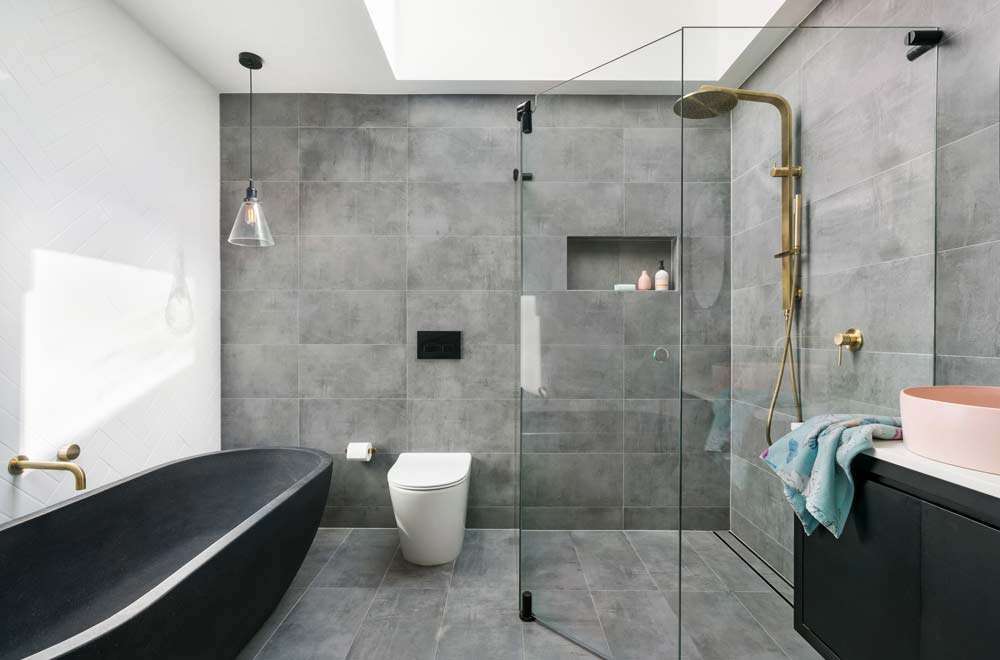
The honest truth about bathtubs in most North Jersey homes: the vast majority of adults stop using them by their mid-30s. The bathtub that was standard equipment in every Colonial, Cape Cod, split-level, and townhouse built across Bergen, Essex, Morris, and Union Counties from 1950 through 1990 reflects a lifestyle pattern that has fundamentally shifted.
Today’s NJ homeowners shower. The bathtub occupies 15 square feet of valuable bathroom real estate, requires stepping over a barrier, and makes the room feel dated and cramped. Converting it to a properly designed walk-in shower transforms the morning routine, the bathroom aesthetic, and the perception of the entire home.
1.4 Space Optimization in NJ’s Compact Homes
North Jersey’s housing stock is overwhelmingly built on smaller lots with more compact room dimensions than newer suburban construction in other states. A standard 5-foot alcove tub occupies the full 5-foot wall in a 5×8 hall bathroom. Replacing it with a 36×48 walk-in shower with frameless glass frees 6 square feet of effective floor area — and the visual transparency of the glass makes the room feel dramatically larger.
In Clifton, Wayne, Passaic, Teaneck, and Fort Lee — where smaller ranches, bi-levels, and condos are common — the spatial gain from removing a bathtub is especially significant. The Powder Room Guys regularly execute tub-to-shower conversions in these communities that make 45–55 square foot bathrooms feel genuinely spacious.
2. Types of Tub to Shower Conversions in NJ
Not all tub-to-shower conversions are the same project. The Powder Room Guys offer four distinct conversion approaches — each appropriate for different budgets, aesthetic goals, and bathroom dimensions. Here is how to choose the right one for your home in Bergen, Essex, Morris, Union, Passaic, or Somerset County.
2.1 Walk-In Shower with Integrated Bench
The walk-in shower with built-in bench is the most popular tub-to-shower conversion in North Jersey’s premium markets — Ridgewood, Summit, Chatham, Basking Ridge, and Montclair. A fully tiled bench built into the corner or back wall of the shower provides seating for comfortable showering, a useful surface, and an accessibility feature that ages well.
- Typical dimensions: 36×60 inches minimum for a functional bench shower; 42×72 inches or larger for true luxury.
- Bench construction: Built-in tiled benches are constructed from cement board and tile — the same materials as the shower walls. They are permanent, waterproof, and maintenance-free.
- Cost premium over basic walk-in: $400–$900 for a standard corner bench; $800–$1,600 for a full-width back-wall bench.
- Most popular in: Master bathrooms in Morris County (Chatham, Madison, Randolph), Bergen County (Ridgewood, Tenafly, Saddle River), and Union County (Summit, Westfield).
2.2 Curbless (Zero-Entry) Shower
The curbless shower — also called a zero-entry, barrier-free, or wet room design — has become the signature feature of premium bathroom renovations across North Jersey. There is no threshold, no step, no curb. The floor slopes gently and continuously to the drain. The result is both the most accessible shower design possible and the most visually luxurious.
- Linear drain: Curbless showers almost always use a linear drain (rather than a center drain) positioned at the shower’s low point. Linear drains by Schluter, Oatey, and ACO are the NJ standard.
- Waterproofing requirement: Curbless showers require an extended waterproofing zone — The Powder Room Guys use Schluter KERDI-BOARD full-pan systems for curbless installations, the gold standard for NJ wet room construction.
- Glass panel vs. full enclosure: Many NJ curbless conversions use a partial glass panel (a “wet wall”) rather than a full enclosure, which reinforces the open, luxury feel.
- Cost premium over standard: $800–$2,200 above equivalent standard shower due to linear drain, extended waterproofing, and precise floor slope work.
- Most popular in: Master bathrooms in South Orange, Maplewood, Montclair (Essex County); Westfield, Summit (Union County); Warren, Watchung, Basking Ridge (Somerset County).
2.3 Tiled Shower vs. Acrylic/Prefab Base
The material choice — custom tile throughout versus an acrylic or fiberglass base with tile walls — is the primary driver of the cost difference between basic and mid-range conversions.
| Option | Base Cost Range | Appearance | Longevity | Maintenance | Best For |
| Acrylic prefab base + tile walls | $3,500–$6,000 | Clean, functional | 15–20 years | Low — no grout on floor | Budget conversions, rental properties |
| Custom tile floor + tile walls | $6,500–$11,000 | Custom, high-end | 25–40+ years | Medium — grout maintenance | Most NJ primary home renovations |
| Porcelain large-format throughout | $8,000–$14,000 | Luxurious, seamless | 30–50+ years | Low — minimal grout lines | Premium NJ market conversions |
| Natural stone (marble, travertine) | $10,000–$18,000+ | Bespoke luxury | 25–40 years (with sealing) | Higher — annual sealing | Bergen/Morris/Somerset luxury homes |
2.4 Glass Enclosures vs. Shower Curtains
This is the single decision that most influences the finished appearance and the perceived value of a tub-to-shower conversion in any NJ home.
- Frameless glass enclosure: The gold standard for NJ bathroom renovations in 2026. A fully custom-measured frameless glass enclosure (3/8″ or 1/2″ tempered glass, minimal hardware) makes the shower feel twice the size, showcases the tile work, and dramatically elevates the overall room. Cost: $1,400–$3,500 installed, depending on configuration.
- Semi-frameless glass (sliding or hinged): A practical middle ground — better than framed, more affordable than frameless. Popular in Wayne, Clifton, Hackensack, and Teaneck conversions where budget is a consideration. Cost: $800–$1,800 installed.
- Framed glass (aluminum frame): Functional but dated. Not recommended for NJ homes in competitive resale markets — the aluminum frame collects mildew and looks dated. Cost: $400–$900.
- Shower curtain: The lowest-cost option and the one that most limits the renovation’s visual impact. Appropriate only for the most budget-constrained conversions or secondary bathrooms in rental properties.
3. Complete Tub to Shower Conversion Cost in NJ — 2026 Breakdown
The cost of a tub to shower conversion in New Jersey varies based on three factors: materials selected, scope of plumbing work required, and the county in which the home is located. Bergen County and Essex County consistently run 10–20% above NJ average. Morris County runs 10–15% above. Union, Passaic, and Somerset Counties track closest to the NJ average.
3.1 Basic Conversion: $3,500–$6,000
The basic tub-to-shower conversion replaces a standard alcove tub with an acrylic or fiberglass shower unit, updates the plumbing connections, and installs new fixtures. No custom tile work. Typically used for secondary bathrooms, rental properties in Clifton, Passaic, Hackensack, and Teaneck, or any situation where budget is the primary constraint.
| Cost Item | Basic Range | Notes |
| Bathtub removal + disposal | $300–$600 | Cast iron tubs heavier — higher disposal cost |
| Plumbing modifications | $600–$1,200 | Relocate drain, update supply lines |
| Acrylic/prefab shower unit | $400–$1,200 | One-piece or 3-piece acrylic surrounds |
| Shower fixtures (Moen/Delta entry) | $200–$500 | Basic pressure-balance valve + showerhead |
| Labor (plumber + tile setter + GC) | $1,200–$2,000 | Limited scope — faster timeline |
| Permits (NJ UCC) | $250–$450 | Required for plumbing changes in all NJ municipalities |
| TOTAL | $3,500–$6,000 | Basic conversion — functional upgrade |
3.2 Mid-Range Custom Tile Conversion: $6,000–$10,000
The mid-range conversion is The Powder Room Guys’ most popular tub-to-shower service tier across Bergen, Essex, Morris, Union, Passaic, and Somerset Counties. Full tile floor and walls. Quality waterproofing. Frameless or semi-frameless glass. Mid-range fixtures. This is the approach that delivers a genuinely transformed bathroom for the typical North Jersey home in Westfield, Montclair, Wayne, Chatham, and Basking Ridge.
| Cost Item | Mid-Range Cost | Notes |
| Bathtub removal + full demo | $600–$900 | Complete tub surround removal to studs |
| Waterproofing membrane (Schluter KERDI) | $400–$700 | Non-negotiable for long-term performance |
| Shower pan / liner (mud bed or prefab) | $400–$800 | Sloped for proper drainage; properly cured |
| Tile — floor (porcelain 4×4 to 2×2 mosaic) | $600–$1,100 | Smaller tile needed on slopes for adhesion |
| Tile — walls (large-format porcelain) | $1,400–$2,800 | Full height to ceiling; includes install labor |
| Built-in shower niche | $200–$400 | Standard in all TPR Guy conversions |
| Semi-frameless or frameless glass | $900–$2,200 | Major visual upgrade; highly recommended |
| Shower fixtures (Kohler/Moen mid-range) | $400–$900 | Thermostatic or pressure-balance; handheld included |
| Labor (all trades + GC management) | $1,600–$2,800 | NJ licensed plumber + tile setter + electrician |
| Permits + inspections | $300–$550 | Full NJ UCC permit set |
| TOTAL | $6,000–$10,000 | Mid-range — genuine transformation |
3.3 Luxury Walk-In Shower Conversion: $10,000–$18,000
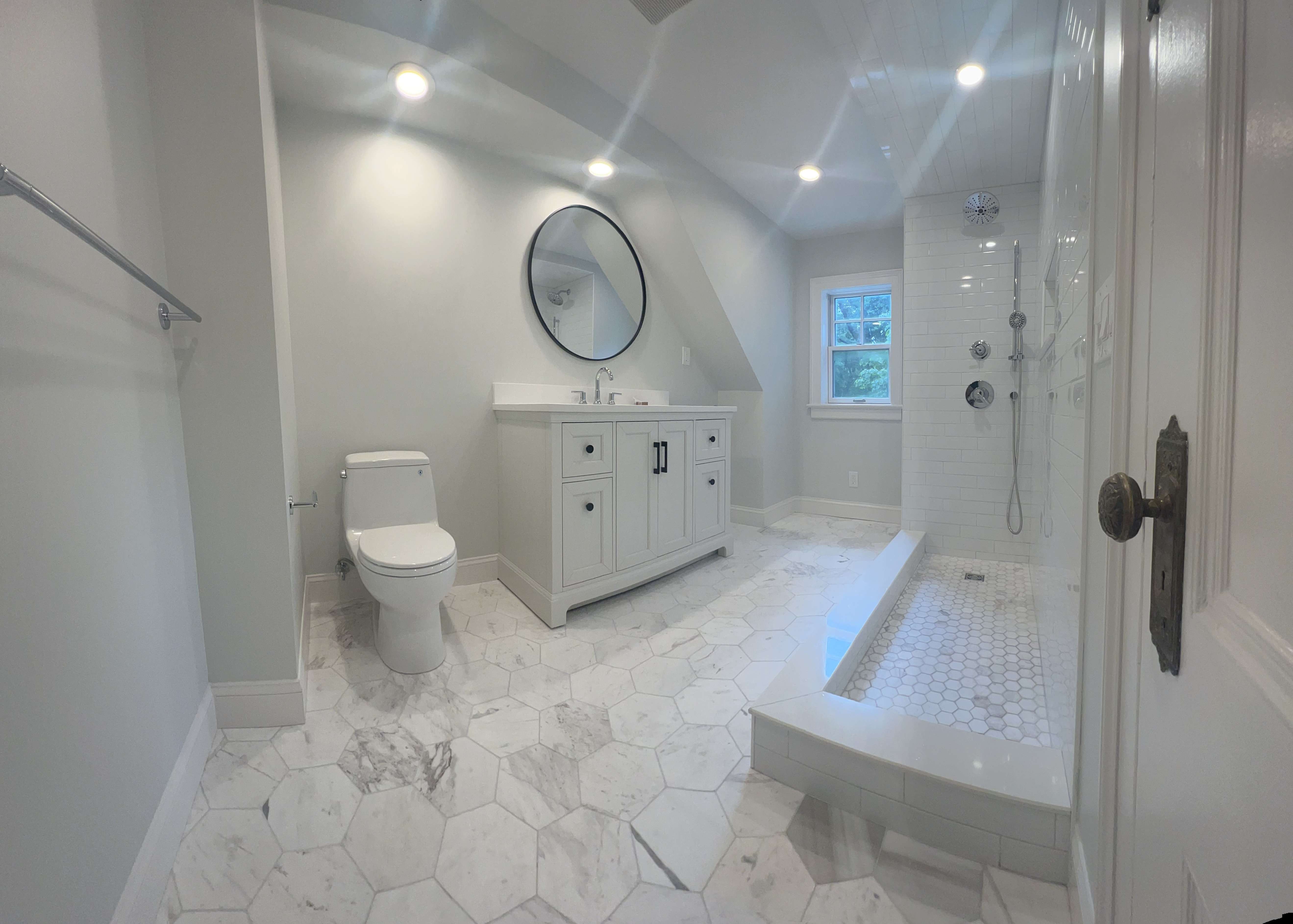
The luxury tub-to-shower conversion is increasingly the standard in Bergen County’s premium towns — Ridgewood, Tenafly, Saddle River, Alpine — and in Morris County’s estate communities — Harding Township, Far Hills, Bernardsville, and Chatham. At this tier, the shower becomes the architectural centerpiece of the bathroom: large-format imported stone or premium porcelain, curbless design, custom linear drain, bespoke frameless glass, and designer fixtures from Hansgrohe, Grohe, or AXOR.
| Cost Item | Luxury Range | Notes |
| Full demolition + structural review | $900–$1,500 | May involve niche headers, framing changes |
| Curbless waterproofing system (full pan) | $800–$1,400 | Schluter KERDI-BOARD or Wedi system |
| Linear drain (Schluter/ACO) | $400–$900 | Custom length to fit shower width |
| Premium tile — floor (large-format stone/porcelain) | $1,600–$4,500 | Natural stone or premium rectified porcelain |
| Premium tile — walls (floor-to-ceiling) | $2,800–$6,500 | Large format; possible feature wall pattern |
| Custom frameless glass (low-iron, 1/2″) | $1,800–$4,000 | Bespoke sizing; ultra-clear glass |
| Designer shower system (Hansgrohe/Grohe) | $1,200–$4,500 | Thermostatic; rain head + handheld + body sprays |
| Integrated bench (tiled) | $600–$1,200 | Full bench with waterproofing |
| Heated shower floor (Nuheat mat) | $500–$900 | Popular addition in NJ luxury conversions |
| Labor (all trades + design-build PM) | $3,000–$5,500 | Reflects NJ premium trade rates + management |
| Permits + inspections | $400–$700 | Full NJ UCC permit set + historic review if applicable |
| TOTAL | $10,000–$18,000 | Luxury conversion — spa-level transformation |
3.4 NJ County Cost Comparison
| County | Basic Conversion | Mid-Range | Luxury | vs. NJ Average |
| Bergen County | $4,200–$7,000 | $7,200–$11,800 | $12,000–$21,000 | +15–20% |
| Essex County | $3,900–$6,700 | $6,700–$11,200 | $11,200–$20,000 | +10–15% |
| Morris County | $3,900–$6,700 | $6,700–$11,000 | $11,000–$19,500 | +10–15% |
| Union County | $3,500–$6,000 | $6,000–$10,000 | $10,000–$18,000 | Average |
| Passaic County | $3,600–$6,200 | $6,200–$10,300 | $10,300–$18,600 | Average to +5% |
| Somerset County | $3,700–$6,400 | $6,400–$10,700 | $10,700–$19,200 | +5–10% |
4. The Tub to Shower Conversion Process — Day by Day
The Powder Room Guys manage every tub-to-shower conversion through a dedicated project app that gives homeowners real-time photo updates at every stage. Here is exactly what happens, from demolition day through final inspection, on a typical mid-range conversion in an NJ home.
Day 1: Demolition and Assessment
The project begins with full demolition of the existing bathtub, tub surround, and all associated tile and substrate. The Powder Room Guys crew removes the tub — which in many North Jersey pre-1990 homes means a heavy cast iron tub (weighing 300–500 lbs) that must be cut into sections for removal. Cast iron tub removal is a specialty skill that requires proper planning and occasionally building management coordination in condo buildings in Fort Lee, Hackensack, and Edgewater.
Once demolition is complete and substrate exposed, Paul’s team performs a critical hidden condition assessment: checking subfloor integrity around the drain area, inspecting supply pipe condition (galvanized pipes are common in pre-1970 homes in Montclair, Glen Ridge, and older Clifton/Passaic neighborhoods), and verifying electrical circuit capacity. Any hidden conditions discovered are documented with photos and reviewed with the homeowner before work continues.
- What happens to the old tub: Cast iron tubs are heavy. They are cut with an angle grinder and removed in sections. Acrylic and fiberglass tubs are lighter but still require careful extraction to avoid wall damage. The Powder Room Guys handle all demo debris disposal as part of every project.
Days 2–3: Plumbing Rough-In and Waterproofing
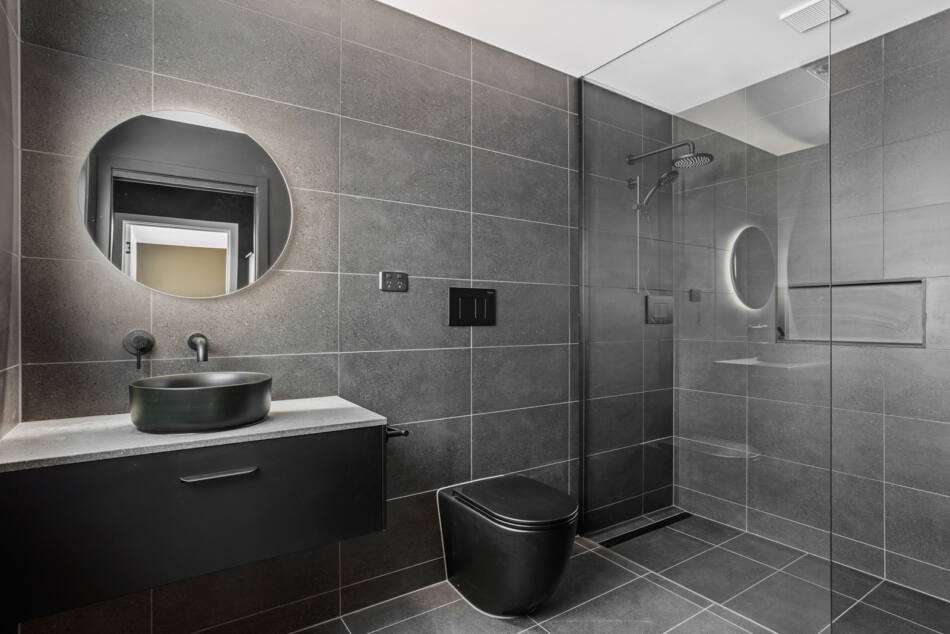
The plumbing rough-in for a tub-to-shower conversion involves several key changes: the drain location typically moves (or is adapted with a conversion fitting), the tub spout supply line is capped, the shower valve rough-in height is set (typically 48 inches from finished floor for a standard shower valve), and the showerhead rough-in is placed at 78–80 inches from finished floor.
In older NJ homes — particularly in Nutley, Bloomfield, Belleville (Essex County), Lodi, Elmwood Park, and Garfield (Bergen County border), and Passaic and Clifton (Passaic County) — this rough-in phase often reveals galvanized steel supply pipes that have narrowed from mineral buildup over decades. The Powder Room Guys always assess supply pipe condition and recommend replacement when flow is compromised. Replacing a bathroom’s galvanized supply runs during a conversion adds $600–$1,400 to the project but eliminates a major future plumbing failure.
After plumbing rough-in and the mandatory NJ rough plumbing inspection, waterproofing begins. The Powder Room Guys apply a full Schluter KERDI waterproofing membrane to all shower walls and the shower pan substrate. This step is the foundation of long-term shower performance — it is what prevents the mold and water damage that The Powder Room Guys routinely find inside the walls of 15–20 year old tub surrounds that were never properly waterproofed.
Days 4–6: Tile Installation
Tile installation for a tub-to-shower conversion in an NJ home is a multi-day process for any custom tile approach. The sequence: shower pan mud bed (or Schluter KERDI-SHOWER tray) is installed and sloped to drain, the tile floor is set and grouted, then wall tile is installed from the bottom up, finishing at the ceiling or top wall termination point.
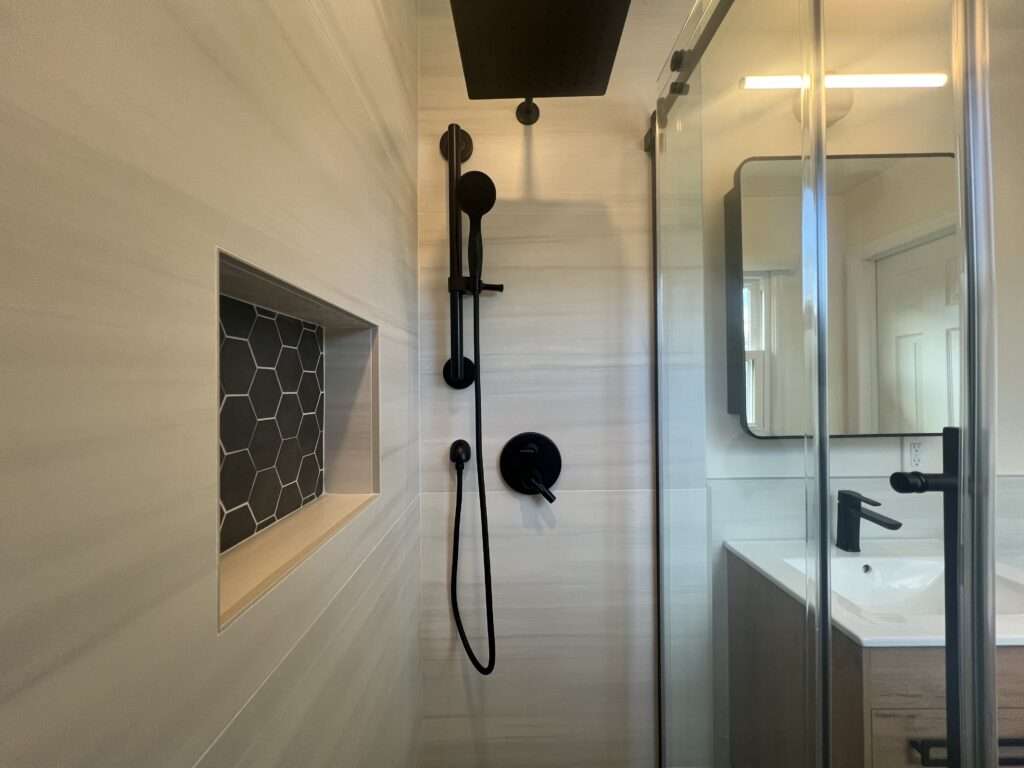
For standard conversions in homes across Bergen, Union, Passaic, and Morris Counties, The Powder Room Guys typically use large-format porcelain (12×24 or 24×24) on walls and 2×2 mosaic or small hex on the floor for proper slip resistance on the sloped pan surface.
Shower niche installation — a standard inclusion in all Powder Room Guys conversions — happens during the tile phase: the niche opening is cut between studs, waterproofed with KERDI membrane, and tiled to match the surrounding wall tile. A properly built shower niche is waterproof, functional, and adds zero floor footprint.
Grout selection matters in NJ’s hard water areas. The Powder Room Guys recommend epoxy grout or stain-proof grout (Laticrete SpectraLOCK) for shower floors in municipalities served by hard water supplies — particularly in Wayne, Clifton, Parsippany, and sections of Bergen County. Standard cement grout stains over time in hard water environments; premium grout does not.
Day 7: Fixtures, Glass, and Finishing
The final on-site day (or two days for luxury conversions) covers fixture installation, glass enclosure installation, and all finishing work. The shower valve and trim are installed and tested. The showerhead(s) and hand shower are connected. The drain cover is set. The frameless glass panels are measured to the finished opening and installed by the glass subcontractor — a specialist trade the Powder Room Guys coordinate directly.
Finishing details include: caulking all transitions (tile-to-glass, tile-to-wall, tile-to-floor) with color-matched silicone; installing towel bars, hooks, and accessories; installing the vanity light if part of the project; and the final walkthrough with the homeowner.
The NJ final building inspection is scheduled for the day after finishing — the Powder Room Guys coordinate directly with each municipality’s Construction Office for this inspection and accompany the inspector on-site.
5. NJ Code Requirements and Permits for Tub to Shower Conversions
New Jersey takes building code compliance seriously — and so does The Powder Room Guys. Every tub-to-shower conversion involving plumbing modifications, electrical changes, or structural work requires a permit under New Jersey’s Uniform Construction Code (UCC). Here is what NJ code specifically requires for a tub-to-shower conversion.
| Requirement | NJ Code Standard | What It Means for Your Project |
| Building permit | NJ UCC R306 (bathroom fixtures) | Required for all fixture changes and plumbing modifications |
| Plumbing permit | NJ UCC P2708 (showers) | Required for drain relocation, supply modification |
| Electrical permit | NJ UCC E4002 (GFCI) | Required for any electrical work — GFCI protection mandatory within 6 ft of water |
| GFCI outlets | NJ UCC requires GFCI within 6 ft of water | All outlets in the bathroom must be GFCI-protected — inspector will verify |
| Shower pan waterproofing | NJ UCC P2709.1 | Liner or membrane waterproofing required; shower pan test required |
| Shower pan flood test | Required before tiling | Shower pan held under water pressure for 24 hours before tile install — inspected |
| Ventilation | NJ UCC M1506 | Bathroom must have code-compliant exhaust ventilation — may trigger fan upgrade |
| Minimum shower dimensions | NJ UCC R307.1 — 30×30 min | No shower enclosure smaller than 900 sq inches (30×30) allowed |
| EPA Lead Safe (pre-1978 homes) | Federal RRP Rule | Required for all renovation work in pre-1978 homes — The Powder Room Guys are certified |
| ⚠️ Permit Warning — Critical for NJ Homeowners Never use a contractor who offers to skip permits on a tub-to-shower conversion in NJ. Unpermitted plumbing work in New Jersey creates major liability: your homeowner’s insurance may deny claims related to water damage from unpermitted plumbing work. When you sell your NJ home, unpermitted bathroom renovations must be disclosed — and will appear in a title search, triggering retroactive permit requirements and potential fines. The Powder Room Guys handle all permit applications, municipality coordination, and inspection scheduling as part of every project. You never deal with your town’s Construction Office. |
6. Accessibility Features for NJ Homeowners: Aging in Place Done Right
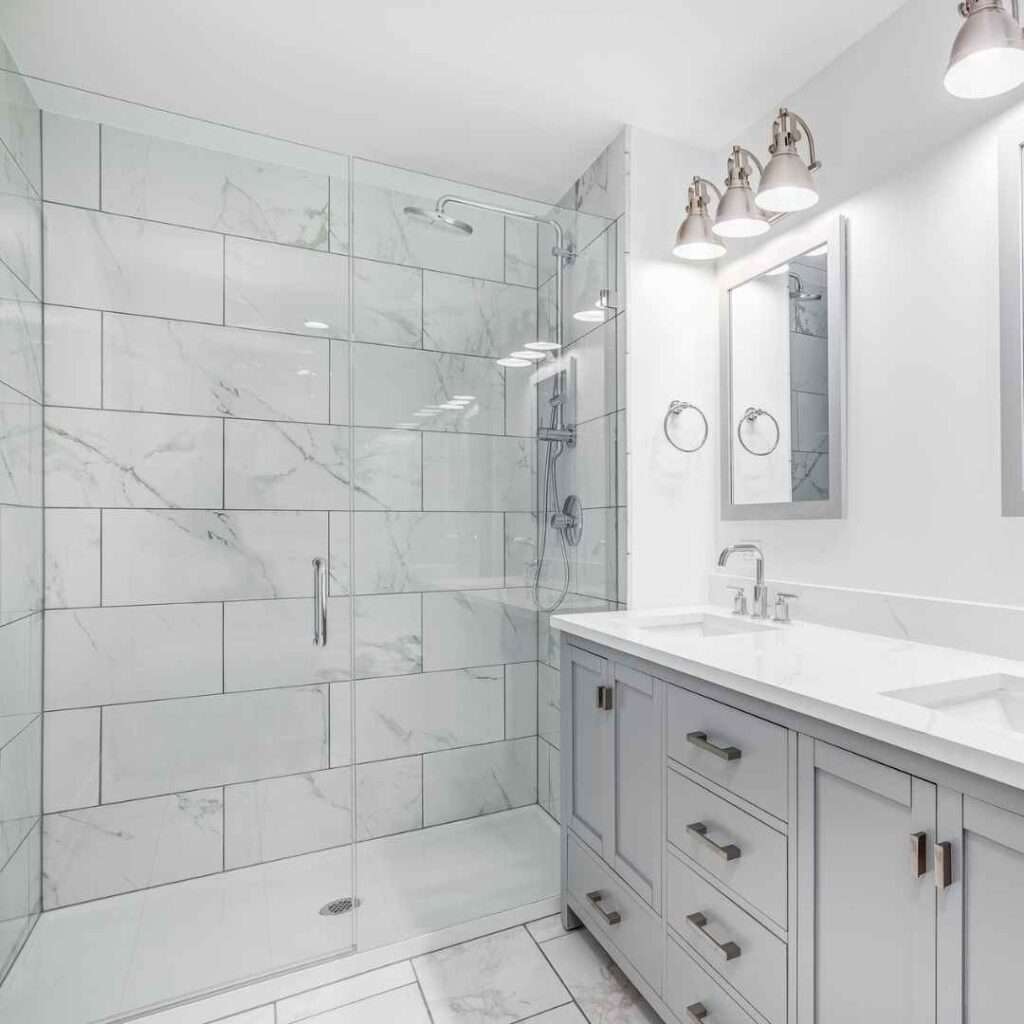
For homeowners in Ridgewood, Chatham, Summit, Basking Ridge, and throughout North and Central NJ who are renovating with long-term occupancy in mind, accessibility features deserve serious consideration. The good news: in 2026 design, accessibility and luxury are not in conflict. The most accessible bathroom design choices also tend to be the most aesthetically sophisticated.
| Accessibility Feature | Cost Addition | Design Impact | Best For |
| Curbless/zero-entry shower | $800–$2,200 | Luxurious — spa-like aesthetic | Best investment for aging in place |
| Grab bars (tiled, designer finish) | $200–$600 | Architectural — looks like a design choice | Essential for 60+ homeowners |
| Grab bar blocking (in-wall) | $150–$300 during rough-in | Invisible — prepared for future install | All homeowners — negligible cost now vs. later |
| Fold-down teak bench | $400–$900 | Elegant — Scandinavian aesthetic | Aging in place + daily comfort |
| Handheld showerhead on adjustable slide | $200–$500 | Standard in premium showers — no stigma | All NJ homeowners — universal benefit |
| Non-slip floor tile (small mosaic/textured) | No premium | Practical — consistent with design | All shower floors — code best practice |
| Lower curb threshold (2-inch vs. 4-inch) | $200–$400 | Minimal visual difference | Transition option — not fully curbless |
| Comfort-height toilet (ADA height) | $50–$200 premium | No visual difference — standard-looking | All 55+ homeowners — highly recommended |
Paul and The Powder Room Guys have completed aging-in-place bathroom renovations across all six service counties — from curbless wet rooms in Basking Ridge and Warren (Somerset County) to fully grab-bar-equipped shower conversions in Chatham and Madison (Morris County). These are not institutional projects. They are beautiful, functional bathrooms built for the long term.
7. Best Materials for Tub to Shower Conversions in the NJ Climate
New Jersey’s climate — cold winters, humid summers, hard water in many municipalities — has specific implications for shower material selection. Here is what the Powder Room Guys specify, based on what actually performs in NJ conditions over the long term.
7.1 Tile Recommendations for NJ Homes
- Porcelain tile (PEI rating 4+): The clear choice for most NJ shower conversions. Porcelain is non-porous (frost-resistant, mold-resistant), extremely durable, and available in every aesthetic from classic to contemporary. Large-format rectified porcelain (24×24, 24×48) is the 2026 premium standard across Bergen, Essex, Morris, and Union County renovation projects.
- Natural stone (with proper sealing): Marble and travertine have their place in NJ luxury bathroom renovations — particularly in Bergen County estate homes and Somerset County properties. They require annual sealing to maintain performance in shower environments. Unsealed natural stone in a NJ shower will stain and deteriorate. The Powder Room Guys always discuss maintenance requirements during the design consultation.
- Ceramic tile (for walls only): Perfectly acceptable on shower walls above the waterline. Not recommended for shower floors where slip resistance and porosity matter.
- Glass mosaic: Beautiful for feature walls and accent borders — and performs well in NJ shower environments when properly installed with the correct thinset and waterproofing.
7.2 Grout for NJ’s Hard Water Areas
Hard water — common in Wayne, Clifton, Parsippany-Troy Hills, Morris Plains, Lodi, Elmwood Park, and many Bergen County communities — is the enemy of standard cement grout. Mineral deposits build up in grout joints over time, staining and discolouring the shower. The Powder Room Guys specify one of two premium grout solutions for all NJ shower projects:
- Laticrete SpectraLOCK Epoxy Grout: The industry gold standard. Fully stain-proof, antimicrobial, and impervious to NJ hard water deposits. Recommended for all shower floors and high-use wall areas.
- Mapei Ultracolor Plus FA (Rapid): A professional-grade polymer-modified cement grout with significantly better stain and water resistance than standard grout. A practical step up from basic grout at moderate premium.
7.3 Waterproofing Systems
- Schluter KERDI Membrane: The Powder Room Guys’ standard specification for shower wall and pan waterproofing on all mid-range and luxury conversions. Industry-leading performance, widely recognised by NJ building inspectors, and backed by Schluter’s product warranty.
- Schluter KERDI-BOARD: Used for curbless conversions and premium projects — a full foam-core panel system that replaces traditional cement board and provides integrated waterproofing.
- Wedi Board: An alternative to KERDI-BOARD for curbless applications — lighter, easier to handle in tight spaces. Used selectively by The Powder Room Guys based on project conditions.
7.4 Glass Enclosures: NJ-Specific Considerations
Frameless glass enclosures are the clear choice for North Jersey bathroom renovations — but NJ’s hard water creates a maintenance consideration. Standard clear glass will develop water spots from mineral deposits over time in Wayne, Clifton, Bergen County well-water areas, and hard municipal water zones. The Powder Room Guys offer two solutions:
- Factory-applied hydrophobic coating (Diamon-Fusion or equivalent): Applied at the glass fabricator. Makes glass surfaces shed water and resist mineral buildup. Highly recommended for NJ hard water areas.
- Low-iron (Starphire/Diamant) glass: Eliminates the green tint of standard glass, producing a water-clear appearance that makes tile colors appear truer. At roughly $400–$800 premium over standard glass, it is a worthwhile upgrade in luxury conversions.
8. Before & After: Real NJ Tub to Shower Conversion Projects
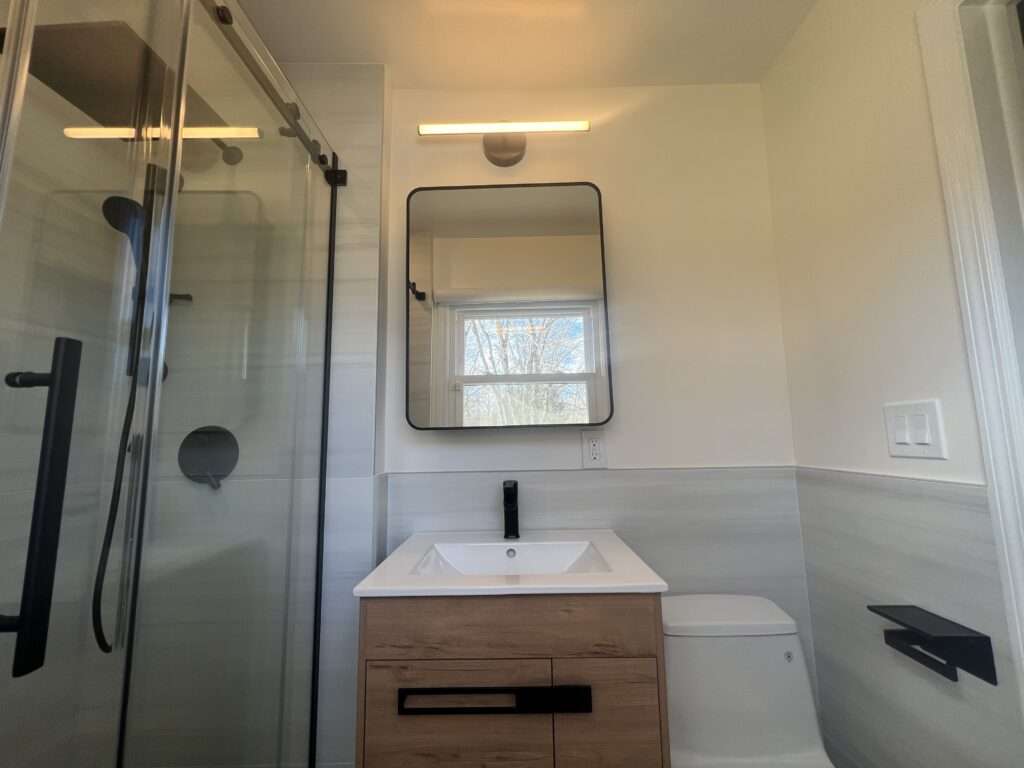
Numbers and specifications only tell part of the story. Here are three real tub-to-shower conversions completed by The Powder Room Guys across North Jersey — with exact costs, timelines, and the homeowners’ own words.
| 📋 BEFORE & AFTER: Tub to Walk-In Shower — Teaneck, Bergen County Scope: Mid-range tub-to-shower conversion — 5×8 hall bathroom Total cost: $8,400 Before: Standard 1970s alcove tub/shower with fiberglass surround. Original Moen fixtures. Pink vinyl flooring. No exhaust fan. Conversion: Tub removed (cast iron — cut and removed in sections). New 36×48 walk-in shower with Schluter KERDI waterproofing. Large-format white porcelain walls to ceiling. 2×2 grey hex mosaic floor. Built-in double niche. Semi-frameless sliding glass door. Kohler Archer faucet set. Panasonic exhaust fan. Plumbing surprise: Original 1970s galvanized supply pipes — replaced with PEX: +$980 (disclosed and approved via project app before proceeding) On-site time: 7 working days Total timeline: 8 weeks (includes Bergen County permit processing — 3.5 weeks) “The Bergen County permit took longer than expected, but Paul kept us fully informed the whole time through the app. When they found the galvanized pipes, there was a photo in the app within an hour and a written change order by the end of the day. The shower is beautiful — worth every dollar.” — Homeowner, Teaneck, Bergen County |
| 📋 BEFORE & AFTER: Luxury Curbless Conversion — Chatham, Morris County Scope: Luxury curbless tub-to-shower conversion — master bathroom Total cost: $16,200 Before: Garden tub in master bathroom — unused for 8+ years. Basic tub surround. Original builder fixtures from 2003. Conversion: Full removal of garden tub and surround. Curbless shower with Schluter KERDI-BOARD full-pan system. Linear drain (ACO, 36″). Floor-to-ceiling large-format Calacatta-look porcelain (48×24). Integrated full-width bench. Custom frameless glass (low-iron, 3/8″). Hansgrohe Raindance E thermostatic system (rain head + handheld + hand spray). Nuheat heated floor mat. Laticrete SpectraLOCK epoxy grout throughout. Timeline: 9 working days on-site | 10 weeks total (custom glass lead time: 4 weeks) Hidden cost found: None — 2003 construction, structurally clean “We had not used that garden tub in a decade. Paul walked us through why the curbless design made sense for us long-term — we are planning to stay in this home through retirement. The result looks like something from a luxury hotel. The heated floor alone changed how we feel about winter mornings in New Jersey.” — Homeowner, Chatham, Morris County |
| 📋 BEFORE & AFTER: Budget-Tier Conversion — Wayne, Passaic County Scope: Budget tub-to-shower conversion — second full bath Total cost: $5,100 Before: 2002 fiberglass tub/shower surround in poor condition (cracking). Leaky Moen valve. No tile. Conversion: Full removal of fiberglass tub/surround. New 36×36 acrylic shower base. Three-piece acrylic wall surround (Swanstone). New Moen Posi-Temp pressure-balance valve with rain head + hand shower. Semi-frameless pivot door. Updated GFCI electrical. Note: Acrylic surround specified at homeowner’s request — second bath, budget priority, 6-year-old home with no hidden plumbing issues expected Timeline: 4 working days on-site | 6 weeks total “We wanted the second bath done quickly and on budget. Paul was completely honest about what we were getting — he explained the difference between the acrylic and tile options clearly and helped us make the right choice for this bathroom. Came in on budget, on time, looks great.” — Homeowner, Wayne, Passaic County |
Frequently Asked Questions: Tub to Shower Conversion in NJ
How much does a tub to shower conversion cost in NJ?
A basic tub-to-shower conversion in New Jersey costs $3,500–$6,000 (acrylic prefab unit, basic fixtures). A mid-range custom tile conversion runs $6,000–$10,000. A luxury walk-in shower conversion with premium tile, curbless design, and designer fixtures costs $10,000–$18,000. Bergen County and Essex County run 10–20% above these averages due to higher labor demand and permit complexity.
Do I need a permit for a tub to shower conversion in NJ?
Yes — any tub to shower conversion involving plumbing modification requires a building permit and plumbing permit under the New Jersey Uniform Construction Code (UCC). Permits must be filed with your municipality’s Construction Office by a licensed NJ contractor. The Powder Room Guys manage all permit applications, inspections, and final sign-off as part of every project across Bergen, Essex, Morris, Union, Passaic, and Somerset Counties.
How long does a tub to shower conversion take in NJ?
On-site construction for a tub-to-shower conversion in NJ takes 4–9 working days depending on scope and materials. Total project timeline — including permit processing and material ordering — is typically 5–10 weeks. Bergen County permit processing can run 3–5 weeks due to 70 separate municipal jurisdictions. Somerset County typically processes faster.
Should I keep a bathtub somewhere in my NJ home?
If you have two or more bathrooms, The Powder Room Guys’ standard recommendation is to maintain one bathtub in the home. This is particularly important for families with young children and for resale considerations — North Jersey buyers with families prefer at least one full-size tub in the home. Converting a second or third bathroom’s tub to a shower is almost always the right decision.
What is the best shower tile for a tub to shower conversion in NJ?
Large-format rectified porcelain tile (12×24 or 24×24) is the best all-around choice for NJ tub-to-shower conversions in 2026. It is non-porous, durable, available in every aesthetic, and performs well in NJ’s hard water areas. For floors, 2×2 or 4×4 porcelain mosaic provides necessary slip resistance on sloped surfaces. Natural stone is an excellent premium option with proper annual sealing.
Can I convert my tub to a shower without replacing the existing tile?
Technically possible but not recommended by The Powder Room Guys. Converting over existing tile without a full gut renovation skips critical waterproofing inspection and replacement — the leading cause of mold and structural damage in shower walls. In most NJ pre-1990 homes, the 20-30 year old waterproofing behind tub surrounds has already failed. A full gut renovation is the right approach for any conversion that you want to stand behind for 15+ years.
Ready for Your NJ Tub to Shower Conversion? Get Started Today
The Powder Room Guys serve homeowners across Bergen County (Ridgewood, Teaneck, Fort Lee, Hackensack, Paramus, Fair Lawn, Mahwah, Ramsey, Wyckoff, Waldwick, Lodi, Garfield, Elmwood Park), Essex County (Montclair, Maplewood, South Orange, Glen Ridge, Bloomfield, Nutley, Belleville, Livingston, Millburn, West Orange), Morris County (Chatham, Morris Plains, Morristown, Madison, Randolph, Denville, Rockaway, Jefferson, Roxbury), Union County (Summit, Westfield, Clark, Cranford, Rahway, Linden, Elizabeth, Scotch Plains, Fanwood), Passaic County (Wayne, Clifton, Passaic, Woodland Park, Little Falls, Totowa, Pompton Lakes), and Somerset County (Basking Ridge, Warren, Watchung, Bridgewater, Bound Brook, Manville, Franklin).
Whether you are in Ridgewood replacing a cast iron tub that has not been used in 20 years, in Clifton converting a secondary bathroom on a practical budget, or in Chatham planning a luxury curbless wet room for your master suite — The Powder Room Guys have the experience, certifications, and craftsmanship to do it right.