Luxury master bathroom renovations have evolved well beyond marble countertops and double vanities. In 2026, the New Jersey homeowners investing $60,000 to $150,000-plus in their primary baths are creating environments that function as private wellness sanctuaries — spaces engineered for daily restoration, calibrated lighting, sensory comfort, and architectural distinction that elevates the entire home.
Across Bergen, Union, Essex, Morris, Passaic, and Somerset counties, the master bathroom has become the second most consequential renovation a homeowner undertakes, ranking behind only the kitchen in resale impact and ahead of every other room in daily quality-of-life return. For New Jersey homes in the $750,000-and-up market, an outdated primary bath now actively suppresses property value — making renovation not a luxury, but a strategic necessity.
This is your complete editorial guide to luxury master bathroom renovations in New Jersey: what design directions are defining 2026, what premium materials and features represent meaningful investments versus marketing trends, what realistic costs look like across renovation tiers, and what separates a true luxury renovation from the standard work that often gets sold as one.
What Actually Defines a Luxury Master Bathroom in 2026
The term ‘luxury bathroom’ has been diluted by overuse, particularly in marketing materials describing renovations that simply use mid-range materials in a slightly larger footprint. True luxury master bathroom renovation in 2026 is defined by a combination of qualities that consistently separate it from the mainstream.
Material specification is the most visible marker. Authentic luxury renovations use natural stone where natural stone belongs — book-matched Calacatta marble shower walls, honed limestone flooring, soapstone vanity tops, or quartzite slabs whose veining was selected from the actual block before fabrication. The difference between a $40 per square foot porcelain look-alike and an $85 per square foot honed Carrara slab isn’t subtle to anyone who handles materials daily.
Fixture quality represents the second clear differentiator. Luxury master baths specify fixtures from European brands like Hansgrohe, Dornbracht, and Vola, or top American lines like Kallista, Brizo Atelier, and California Faucets. These fixtures carry meaningful engineering and longevity premiums over mid-market alternatives — proper thermostatic valves, brass internals rather than plastic, and finishes that maintain their appearance for decades rather than years.
Architectural integration is the most overlooked luxury marker. Standard renovations work within existing footprints and architectural constraints. Luxury renovations reshape space — relocating walls, expanding into adjacent closets, reconfiguring window placement, raising ceiling heights, or creating spatial sequences (a vestibule entering into the main bathroom volume, a separate water closet, a discrete dressing area) that fundamentally change how the room functions.
Lighting design at the luxury tier moves beyond a single overhead fixture or vanity sconces. True luxury master baths include layered lighting strategies — ambient illumination, task lighting at the vanity and shower, accent lighting for architectural features, and tunable white temperatures that shift throughout the day to support natural circadian patterns.
Defining 2026 Master Bathroom Design Directions
Several distinct design directions are dominating luxury master bathroom renovations across New Jersey in 2026, each appealing to different homeowner sensibilities and architectural contexts.
The Resort Spa Direction
Drawing inspiration from high-end resort properties — particularly the wellness-focused spa architecture of Aman Resorts, Six Senses, and Amangiri — this direction emphasizes natural materials, restrained palettes, ample natural light, and integrated wellness features. Stone-clad walk-in showers with multiple heads, freestanding tubs positioned for views, heated stone flooring, and steam shower capabilities define the architectural language.
Color palettes lean into warm neutrals — honed travertine, oak-toned cabinetry, brushed aged brass or pewter finishes — that create environments calibrated for daily restoration. The Resort Spa direction works particularly well in larger primary suites where space supports the architectural breathing room these designs require.
The Modern Heritage Direction
Particularly suited to New Jersey’s substantial inventory of pre-war and mid-century homes in towns like Montclair, Summit, Westfield, Maplewood, and Princeton, the Modern Heritage direction integrates contemporary fixtures and engineering with architectural sensibilities that honor the home’s original character.
Subway tile in traditional 3×6 dimensions returns at the luxury level, paired with hand-glazed finishes that reveal the maker’s hand. Hexagonal floor tiles in stone or unlacquered brass mosaic patterns. Vanities built as freestanding furniture pieces rather than mass-produced cabinetry. Polished nickel or unlacquered brass fixtures that develop authentic patina over years of use. The Modern Heritage direction tends to age beautifully — designs completed today will look intentional and considered in 2046, not dated.
The Minimalist Architectural Direction
For homeowners drawn to clean lines, restraint, and architectural rigor, the Minimalist Architectural direction strips bathroom design to essential elements executed at the highest level. Large-format porcelain or stone slabs minimize grout lines. Wall-hung fixtures float above floors that flow uninterrupted from one side of the room to the other. Hidden storage maintains visual quiet. Lighting becomes architectural rather than decorative — integrated linear fixtures, cove lighting, and concealed sources that illuminate without revealing themselves.
The challenge of minimalist luxury is that nothing hides poor craftsmanship. Every joint, every transition, every tile alignment must be executed perfectly because the design provides no decorative distraction. This direction demands contractors with both the skill and the temperament for exacting work.
Premium Features That Justify Their Investment
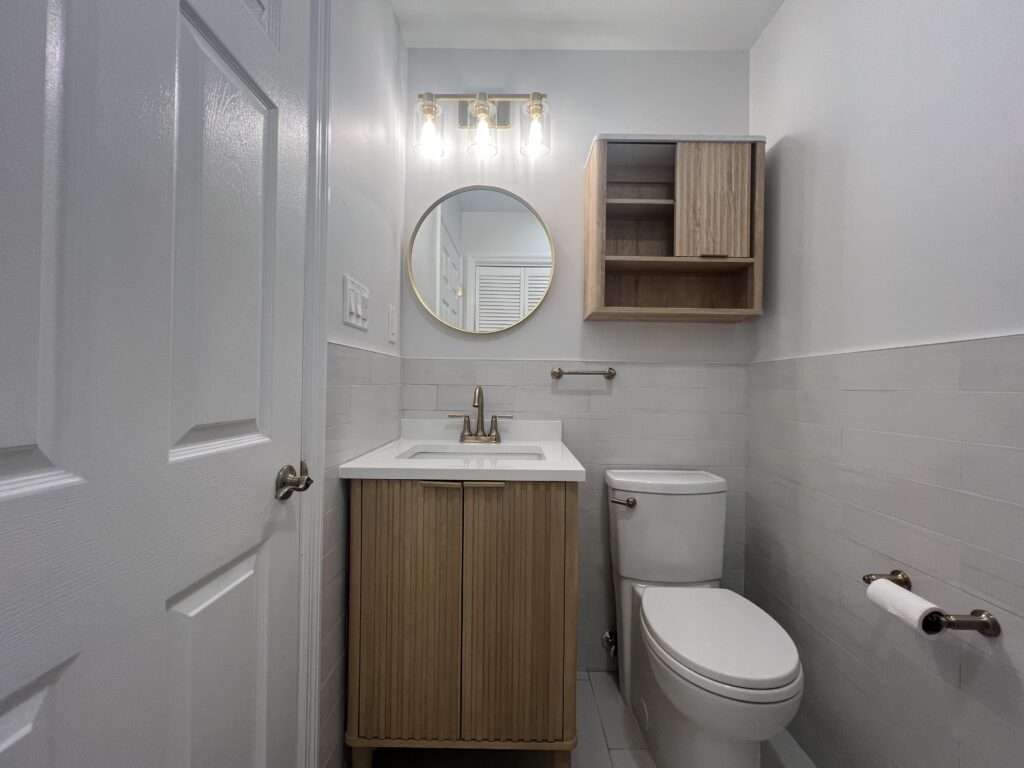
Luxury master bathroom renovations involve specifying features whose costs significantly exceed standard alternatives. Some of these features represent meaningful daily value; others are largely status purchases. Understanding the difference helps homeowners allocate budget thoughtfully.
Features Worth the Investment
Heated flooring transforms cold-weather mornings and is impossible to retrofit later without tearing up the bathroom floor. The incremental cost during renovation typically runs $1,800 to $3,500 depending on bathroom size, and few homeowners regret the addition once they’ve lived with it.
Steam shower capabilities add meaningful daily wellness value and create a feature buyers consistently respond to. Proper steam shower installation requires waterproofing extending to ceiling height, a sloped steam-containing ceiling, vapor-tight door seals, and a dedicated steam generator. Total incremental cost during a luxury renovation runs $4,000 to $9,000 depending on shower size and steam generator specification.
Toto Neorest or comparable smart toilet installations replace the standard toilet with units that include heated seats, integrated bidet functionality, automatic flushing, and air drying. The hygiene and daily experience improvements are substantial; total investment runs $4,500 to $7,500 depending on model.
Custom millwork vanities and built-in storage represent significant upgrade value over factory cabinetry. A custom vanity built by skilled carpenters with high-quality hardware, dovetailed drawers, and integrated soft-close mechanisms typically runs $8,000 to $18,000 — meaningful money, but the resulting piece functions as furniture-grade casework that elevates the entire room.
Features With Diminishing Returns
Multiple shower body sprays beyond a primary head and handheld typically deliver less daily value than their cost suggests. Many homeowners report rarely using shower body sprays after the novelty fades, while the additional valves and plumbing complexity add to maintenance burden.
Television installation in bathrooms has declined sharply as a desired feature. Smartphone and tablet integration through Bluetooth speakers delivers most of the entertainment value at a fraction of the cost without dating the bathroom’s overall aesthetic.
Jetted whirlpool tubs have largely been replaced by freestanding soaking tubs in luxury renovations. Whirlpool tubs require ongoing motor and jet maintenance, accumulate mineral deposits in internal piping, and represent dated 1990s and 2000s luxury vocabulary that current high-end design has moved past.
Luxury Master Bathroom Renovation Costs in New Jersey
Realistic cost expectations help homeowners plan thoughtfully and recognize lowball quotes for what they are. Across New Jersey’s $750,000-and-up housing markets, luxury master bathroom renovations consistently fall within specific price ranges based on scope and material specification.
Entry-level luxury renovations — those featuring custom tile work, mid-tier natural stone, semi-custom cabinetry, premium American-made fixtures, and standard primary bath features — typically run $55,000 to $85,000 for primary baths in the 100-to-150 square foot range. This tier represents meaningful upgrade over standard renovation without the highest-end material specifications.
Mid-tier luxury renovations — featuring natural stone slabs, custom millwork vanities, European fixture lines, heated flooring, premium lighting design, and one or two specialty features like steam shower or smart toilet — typically run $85,000 to $140,000 for similarly sized primary baths.
High-end luxury renovations — featuring book-matched stone slabs, fully custom architectural millwork, complete European fixture suites, multiple specialty features, architectural reconfiguration of the existing space, and bespoke lighting design — run $140,000 to $250,000-plus, with larger primary suites approaching or exceeding $400,000 in genuinely architect-driven renovations.
These figures include labor, materials, permits, fixtures, tile, custom millwork, and project management. They reflect actual completed luxury renovations across New Jersey rather than the lowball quotes that some marketing-driven contractors advertise to win contracts they later inflate through change orders.
Return on Investment for Luxury Master Bathrooms
The 2025 Remodeling Cost vs Value Report showed master bathroom renovations recovering between 50% and 71% of their cost at resale, depending on regional market and renovation tier. New Jersey markets, particularly in higher-value townships, consistently fall toward the higher end of this range — and luxury renovations in $1 million-plus homes often exceed the national average significantly.
More importantly, luxury master bathrooms have become a make-or-break feature for buyers in higher-end New Jersey markets. A dated primary bath in a $1.5 million home doesn’t just reduce sale price; it extends days on market and weakens negotiating position. Buyers in this market segment expect contemporary primary baths and will demand price concessions reflecting full renovation cost when they encounter dated spaces.
Beyond direct ROI, luxury master bathroom renovations deliver daily quality-of-life return that conventional financial analysis can’t fully capture. The cumulative value of 365 days of daily restoration in a thoughtfully designed personal sanctuary, repeated across years of ownership, represents real value even before resale considerations.
What Separates Luxury Bathroom Contractors From Standard Operators
Hiring the right contractor for a luxury master bathroom renovation matters more than for any other renovation tier. Material complexity, fixture sophistication, and tolerance requirements all rise substantially at this level, and contractors without genuine luxury experience often deliver disappointing results despite quality intentions.
Genuine luxury contractors maintain ongoing relationships with high-end material suppliers, fixture distributors, and specialty tradespeople. They understand which tile setters can execute book-matched stone installations and which can’t. They know which plumbers can rough-in for thermostatic valve systems correctly and which will need supervision. They have working relationships with custom millwork shops capable of furniture-grade vanity construction.
Communication style differs at the luxury level. Standard contractors often resist material upgrades that complicate their work; luxury contractors guide homeowners toward material selections that justify the investment and away from choices that don’t. Standard contractors quote tightly to win bids; luxury contractors quote accurately to maintain margins through complex projects.
The Powder Room Guys have completed luxury master bathroom renovations across New Jersey’s premier residential markets. Our team works regularly with high-end material suppliers, maintains relationships with the specialized tradespeople these projects require, and approaches every luxury renovation with the precision and accountability that homeowners at this investment level expect.
| Schedule Your Luxury Master Bathroom Consultation Speak with our team about your master bathroom vision. We’ll visit your home, assess your existing primary bath, discuss design directions and material possibilities, and provide a transparent estimate aligned with your renovation goals. Complimentary in-home consultations across Bergen, Union, Essex, Morris, Passaic, and Somerset counties. ▸ Schedule Your Free Consultation |
Frequently Asked Questions About Luxury Master Bathroom Renovations
Q: How long does a luxury master bathroom renovation typically take?
Standard luxury renovations require eight to twelve weeks from demolition through final walkthrough. Renovations involving significant architectural reconfiguration, custom millwork production, or specialty features like steam showers may extend to fourteen to eighteen weeks. Material lead times often drive overall timelines more than construction labor.
Q: Should I work with an interior designer for a luxury master bathroom renovation?
For renovations involving architectural reconfiguration, complex material specifications, or design directions outside your personal expertise, working with an interior designer or architect alongside your contractor typically improves outcomes substantially. The Powder Room Guys collaborate effectively with both independent designers and design-build approaches depending on each homeowner’s preference.
Q: Can luxury features be added to a renovation later, or do they need to be specified upfront?
Some features can be retrofitted — exhaust fans, lighting fixtures, and accessories. Many cannot — heated flooring, steam shower capabilities, plumbing for specialty fixtures, and structural changes for tub or shower relocations must be specified upfront because retrofitting requires reopening the renovation. We discuss future-proofing strategies during initial consultations.
Q: How do I evaluate which materials and features will hold their value over time?
Generally, classic material choices in high-quality executions age better than trend-driven selections. Honed natural stone, polished nickel or aged brass fixtures, white quartzite slabs, and architectural millwork tend to look intentional decades after installation. Highly trend-specific selections — particular colored fixtures, dramatic patterned tiles, or signature design moments — may date more quickly. Our team helps you balance personal expression with long-term timelessness.