Bergen County represents one of the most distinctive bathroom renovation markets in the entire northeastern United States. With seventy distinct municipalities ranging from densely settled urban centers like Hackensack to estate-quality enclaves like Alpine and Saddle River, the renovation landscape varies dramatically depending on which Bergen County township a home sits in. Housing stock spans more than a century of construction eras, architectural sensibilities differ substantially between northern and southern parts of the county, and homeowner expectations reflect the substantial median household incomes that characterize the region.
What unites Bergen County bathroom renovation across all this diversity is a consistent commitment to quality work. Bergen County homeowners, more than perhaps any other New Jersey county, invest meaningfully in their homes — and they expect renovation partners who match that commitment with genuine expertise, transparent process, and craftsmanship that holds its value for decades.
This is your complete guide to bathroom renovation in Bergen County for 2026: what local market conditions look like across price points, which design directions are defining contemporary work, what realistic costs run across township markets, what the permit process involves at the municipal level, and how to identify the contractors genuinely equipped to deliver Bergen County-quality renovations.
Understanding Bergen County’s Diverse Housing Stock
Bergen County’s bathroom renovation considerations vary substantially depending on the era and architectural type of the underlying home. Understanding these categories helps homeowners anticipate the scope, complexity, and likely investment range for their specific property.
The county’s pre-1940 housing stock concentrates in established communities like Ridgewood, Glen Ridge, Tenafly, Englewood, Cresskill, Demarest, Ho-Ho-Kus, and the older sections of Hackensack and Fair Lawn. These homes — Victorian, Colonial Revival, Tudor, and early Craftsman — frequently retain original plumbing infrastructure approaching the end of functional life. Cast-iron drain stacks, galvanized supply pipes, and undersized venting are common. Renovations in these properties typically include comprehensive mechanical upgrades alongside the cosmetic work.
The substantial inventory of postwar housing built between 1945 and 1970 fills neighborhoods across most Bergen County townships. These homes — ranches, split-levels, and modest colonials — generally have sound but dated infrastructure. Original fiberglass tub-shower combinations, builder-grade vanities, and minimal lighting characterize their bathrooms. Modern renovations focus on transformation of these dated finishes alongside selective mechanical upgrades for ventilation, electrical code compliance, and modern fixture support.
Bergen County’s contemporary housing stock — from the 1980s onward — features larger primary bathroom footprints, more substantial original specifications, and infrastructure that typically supports renovation without extensive mechanical replacement. Renovation work in these properties focuses on aesthetic and functional transformation rather than mechanical rebuilding.
Bathroom Renovation Markets Across Bergen County Townships
Bergen County’s seventy municipalities don’t represent a single renovation market — they represent dozens of distinct markets with different price points, design sensibilities, and homeowner expectations.
The eastern Bergen County corridor — Tenafly, Englewood, Englewood Cliffs, Cresskill, Demarest, Alpine, and Old Tappan — anchors the upper end of the Bergen County renovation market. Median home values in this corridor frequently exceed $1.5 million, and bathroom renovation budgets reflect that context. Standard renovations in these townships rarely run below $35,000, with master bath renovations commonly reaching $80,000 to $150,000 or higher.
The central Bergen County markets — Hackensack, Teaneck, Bergenfield, Dumont, New Milford, River Edge, and Oradell — represent diverse middle-market renovation activity. Single-family home values typically range from $500,000 to $1 million, with bathroom renovation budgets aligning with property values and homeowner intentions for length of tenure.
The western Bergen County markets — Fair Lawn, Glen Rock, Ridgewood, Ho-Ho-Kus, Allendale, Saddle River, Upper Saddle River, and Woodcliff Lake — combine established residential character with substantial home values, particularly in the higher-end townships. Ridgewood and Ho-Ho-Kus markets sit between the eastern corridor and central markets in typical renovation investment.
The southern Bergen County markets — Lyndhurst, Rutherford, East Rutherford, Wood-Ridge, Hasbrouck Heights, and the surrounding townships — feature more modest median home values and correspondingly different renovation investment patterns. Standard bathroom renovations in these markets typically run $18,000 to $30,000, with selective premium renovations in higher-value properties.
Bergen County Bathroom Renovation Pricing Realities
Realistic Bergen County bathroom renovation pricing varies based on township market context, scope of work, and material specification. The following ranges reflect actual completed projects across the county and provide useful benchmarks for homeowners planning renovations.
Partial bathroom makeovers — focused on vanity replacement, countertop and sink updates, floor and shower tile refresh, lighting upgrades, paint, hardware, and new toilet without structural or plumbing relocation — typically run $9,500 to $18,000 across Bergen County, with the upper range reflecting eastern corridor markets and premium material selections.
Standard full demolition remodels of hall bathrooms in the 40-to-60 square foot range typically run $22,000 to $42,000 across Bergen County, with significant variation based on township market and specification level. Mid-range full renovations cluster around $28,000 to $35,000; higher-specification renovations approach the $40,000-plus range.
Master bathroom full renovations in the 100-to-150 square foot range typically run $40,000 to $80,000 for standard luxury specifications, with high-end renovations in the eastern corridor reaching $90,000 to $150,000 or higher. Renovations involving architectural reconfiguration, custom millwork, or specialty features extend beyond these ranges.
These figures include labor, materials, permits, fixtures, tile, and project management. Bergen County’s older housing stock often surfaces additional conditions during demolition — original lead supply lines, knob-and-tube wiring fragments, undersized joists requiring sister-joisting — that responsible contractors discuss as contingencies during the estimate visit.
Bergen County Permit Process and Municipal Differences
Each of Bergen County’s seventy municipalities maintains its own construction office with specific permit procedures, fee structures, and inspector relationships. While the underlying New Jersey Uniform Construction Code applies uniformly, the practical experience of working through the permit process varies substantially township to township.
Larger Bergen County municipalities like Hackensack, Teaneck, Fair Lawn, and Paramus maintain construction offices with multiple inspectors and faster turnaround times for both permit approval and inspection scheduling. Smaller municipalities may have part-time inspectors with more limited availability, occasionally extending inspection scheduling windows. Historic districts in townships like Ridgewood, Tenafly, and Englewood may add architectural review requirements for properties within designated boundaries.
Working with a contractor experienced specifically in your Bergen County municipality matters substantially. Local familiarity with construction officials, knowledge of common inspection priorities, and established working relationships smooth the permit and inspection process in ways that meaningfully affect renovation timelines.
Design Directions Defining Bergen County Renovations in 2026
Bergen County bathroom renovations in 2026 reflect several distinct design directions, with regional preferences varying somewhat between northern and southern parts of the county and between urban and estate-context properties.
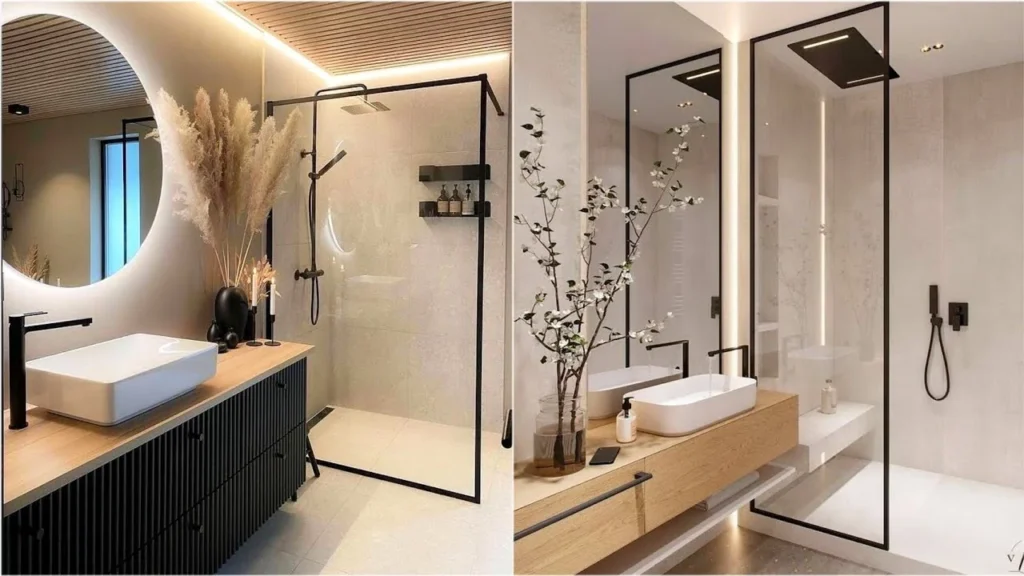
Contemporary luxury — characterized by large-format porcelain or stone slabs, wall-hung fixtures, frameless glass enclosures, integrated linear lighting, and minimal hardware — defines much of the upper-end renovation work in eastern Bergen County. This direction emphasizes architectural cleanliness and material substance over decorative elements.
Modern heritage approaches — pairing contemporary fixtures and engineering with materials and proportions sympathetic to original architecture — characterize substantial renovation activity in Ridgewood, Tenafly, Glen Rock, and other communities with significant pre-war housing stock. Subway tile in traditional dimensions, hexagonal mosaic floors, polished nickel or unlacquered brass fixtures, and furniture-style vanities define this approach.
Spa-inspired wellness design — featuring freestanding tubs, generous walk-in showers with multiple heads, heated flooring, steam capabilities, and warm material palettes — appears in master bathroom renovations across all Bergen County markets, with particular prevalence in larger primary suite renovations.
Compact luxury renovations of small primary baths and hall bathrooms in space-constrained homes have driven significant innovation in space-efficient luxury design. Wall-hung toilets and vanities create floor space visibility, curbless shower designs eliminate visual barriers, and considered storage solutions maintain function in tight footprints.
Selecting a Bergen County Bathroom Renovation Contractor
Bergen County’s renovation market includes hundreds of contractors offering bathroom services. Selecting the right partner for your specific project requires looking past marketing materials to substantive markers of capability and accountability.
Bathroom-only specialization matters enormously at every renovation tier. General contractors splitting attention across kitchens, additions, basements, and bathrooms operate with fundamentally different economics and skill development than specialists who focus exclusively on bathroom work. The cumulative experience of completing hundreds of bathroom projects across Bergen County creates expertise that simply can’t be matched by occasional bathroom work between other project types.
New Jersey Home Improvement Contractor (HIC) license verification is non-negotiable. Verify license status through the New Jersey Division of Consumer Affairs online lookup before signing any contract. Insurance verification matters equally — request current certificates showing general liability and workers’ compensation coverage naming your home address as additional insured before work begins.
EPA Lead-Safe Renovator certification is required for any renovation work in homes built before 1978, which includes substantial portions of Bergen County’s housing stock. Contractors without this certification cannot legally perform demolition work in pre-1978 homes — making this a both a regulatory and a safety consideration.
Local Bergen County experience surfaces in subtle but important ways throughout a renovation. Contractors who regularly work in Bergen County understand municipal permit nuances, know which suppliers maintain inventory of materials common in local renovations, and recognize the structural patterns common in different eras of Bergen County housing. This experience translates into smoother projects with fewer surprises.
The Bergen County Bathroom Renovation Timeline
Bergen County bathroom renovations typically follow predictable timeline patterns, though specific projects vary based on scope, material lead times, and unexpected conditions surfaced during demolition.
Partial bathroom makeovers generally complete within six to nine working days from demolition through final walkthrough. Standard full demolition remodels of hall bathrooms typically require fifteen to twenty-two working days. Master bathroom full renovations run twenty-five to thirty-five working days. Luxury renovations involving custom millwork, specialty materials, or architectural reconfiguration extend to forty to sixty working days based on scope.
Material lead times often affect overall renovation duration more than construction labor. Custom natural stone slabs may require eight to twelve weeks from selection to fabrication and installation. Custom millwork vanities may require six to ten weeks. Specialty European fixtures may require four to eight weeks. Building these lead times into project planning prevents unnecessary delays and supports realistic completion expectations.
| Plan Your Bergen County Bathroom Renovation Speak with our team about your bathroom renovation. We work throughout Bergen County’s seventy municipalities and bring focused bathroom-only expertise to projects across every market segment. Complimentary in-home consultations available throughout Bergen County. ▸ Schedule Your Free Consultation |
Frequently Asked Questions About Bergen County Bathroom Renovation
Q: How does Bergen County bathroom renovation pricing compare to surrounding counties?
Bergen County renovation pricing generally exceeds Essex and Union County averages by 5% to 15% in central county markets and significantly more in eastern corridor luxury markets. Higher labor costs, more expensive municipal fees, and elevated material expectations contribute to the differential.
Q: What’s the best time of year to undertake a Bergen County bathroom renovation?
Bergen County contractors typically maintain consistent workloads throughout the year, but late winter through early spring (January through March) often offers slightly better scheduling availability than peak demand months of April through October. Material lead times remain consistent year-round.
Q: Do Bergen County permit requirements vary significantly between townships?
Underlying code requirements are consistent county-wide, but practical permit experience varies between municipalities. Larger townships typically offer faster turnaround and more accessible construction offices; smaller townships may have more limited inspector availability.
Q: Are renovation costs in Bergen County’s eastern corridor really that much higher than central markets? Yes — eastern corridor renovations from Tenafly to Alpine consistently run 20% to 40% higher than central county pricing for comparable scope, reflecting elevated material expectations, higher labor costs, more complex permit processes in historic districts, and homeowner expectations driving toward premium specifications.