Every bathroom renovation in New Jersey represents two distinct investments competing for attention in homeowner thinking: the daily quality-of-life investment that comes from living with a renovated space, and the financial investment whose return materializes only at resale. For some homeowners, the daily quality-of-life return alone justifies the renovation regardless of financial recapture. For others, particularly those planning to sell within five to ten years, the financial return weighs heavily in renovation decisions.
Understanding bathroom renovation return on investment with genuine accuracy — rather than the marketing claims that contractors sometimes promote — helps New Jersey homeowners make sound decisions about scope, specification, and timing. The reality of bathroom renovation ROI in New Jersey is more nuanced than blanket statistics suggest, with returns varying significantly based on market segment, renovation tier, design choices, and the existing condition of the home.
This is your complete editorial guide to bathroom renovation ROI in New Jersey for 2026: what national and regional data actually shows about returns, which factors meaningfully affect ROI in the New Jersey market specifically, what renovations consistently deliver above-average returns, and how to think about the daily quality-of-life return that financial analysis can’t fully capture.
What National ROI Data Actually Shows for Bathroom Renovation
The most cited source for renovation ROI data is the annual Remodeling Cost vs Value Report, which surveys real estate professionals nationally about renovation returns. The 2025 report — the most recent comprehensive industry analysis — provided several useful benchmarks for bathroom renovation specifically.
Midrange bathroom remodels — defined as approximately $25,000 to $35,000 projects covering standard hall or guest bathrooms with quality but not premium specifications — averaged 60% to 67% cost recapture at resale nationally. Upscale bathroom remodels — defined as approximately $50,000 to $90,000 projects with premium specifications — averaged 45% to 58% cost recapture.
These figures represent national averages, and the variations between metropolitan markets are substantial. New York metropolitan area renovations, which include all of northern New Jersey, consistently exceed national averages — typically by 10% to 15% across both midrange and upscale categories. New Jersey-specific data, when isolated, shows midrange bathroom renovations averaging 68% to 75% cost recapture and upscale renovations averaging 55% to 68% — meaningfully better than national figures.
Several factors drive New Jersey’s stronger ROI performance. Higher housing values in the region absorb renovation costs more proportionally. Buyer expectations for updated bathrooms run higher in New Jersey’s competitive markets, making dated bathrooms more significant negative factors. Construction quality expectations are higher, meaning that well-executed renovations are recognized and rewarded by buyers willing to pay for quality.
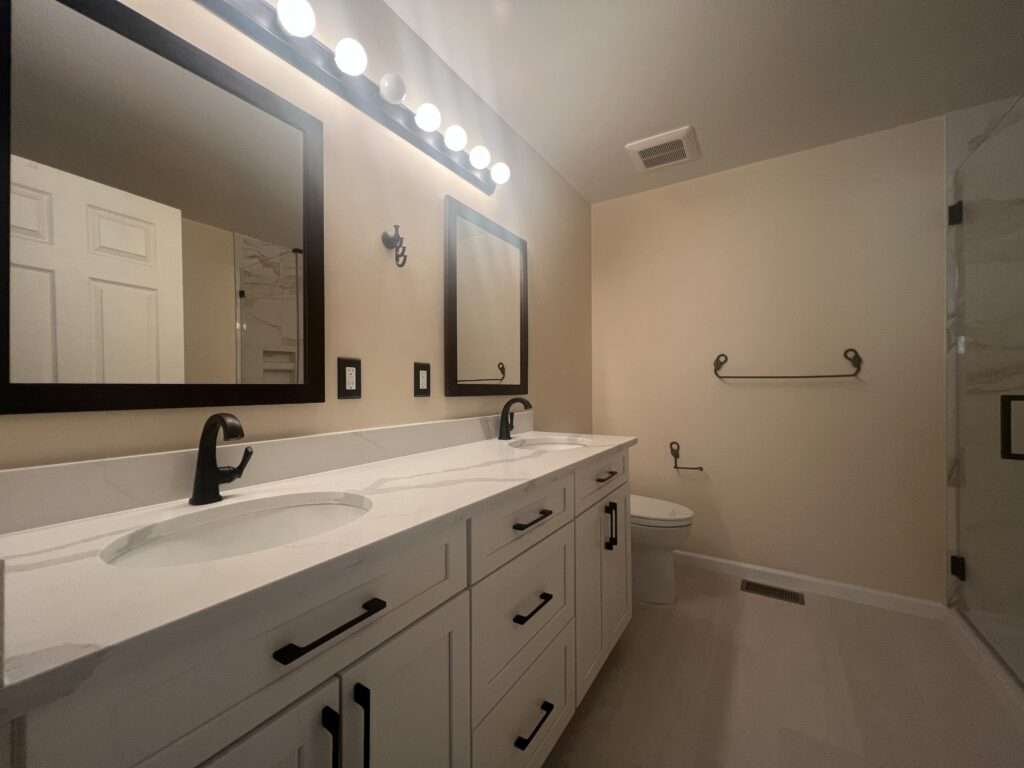
The Hidden ROI: Avoiding Negative Value From Outdated Bathrooms
The most overlooked dimension of bathroom renovation ROI is the negative value an unrenovated bathroom creates in higher-end New Jersey markets. ROI calculations typically focus on what renovation adds; they often fail to capture what unrenovated condition subtracts.
In New Jersey housing markets above $750,000, a dated bathroom doesn’t just fail to add value — it actively reduces sale price by amounts often exceeding renovation cost. Buyers in this market segment expect contemporary, quality bathrooms. When they encounter dated spaces, they discount their offers by full renovation cost plus disruption premium, and they extend negotiations to capture additional concessions.
Real estate agents working New Jersey’s higher-end markets consistently report that dated bathrooms drive longer market times, weaker negotiating positions, and ultimately lower sale prices than what comparable updated homes achieve. The financial impact of this dynamic often exceeds the cost of the renovation itself — meaning the actual return on a bathroom renovation in higher-end New Jersey markets is frequently greater than direct cost recapture suggests.
This dynamic concentrates in higher-value markets. In housing markets below $400,000, the negative value of outdated bathrooms is more muted, and ROI calculations more closely match cost recapture figures from national data.
Which Bathroom Renovations Deliver the Strongest ROI
Not all bathroom renovations produce equivalent returns. Several patterns emerge consistently from New Jersey market data about which renovation approaches deliver above-average ROI.
Master Bathroom Renovations in Mid-to-High-Value Homes
Master bathroom renovations in homes valued $750,000 and above consistently deliver the strongest ROI in New Jersey markets. The combination of buyer expectations, market positioning, and the increased significance of primary bath quality in higher-value purchases drives returns substantially above renovation cost recapture averages.
Master bathroom renovations in homes valued under $500,000 typically deliver more modest returns because buyer expectations in this market segment are less concentrated on bathroom premium features. Standard updated quality matters more than luxury specifications.
Tub-to-Shower Conversions
Tub-to-shower conversions consistently deliver strong ROI when at least one bathtub remains elsewhere in the home. The conversion improves daily function for the substantial majority of buyers who prefer showers, eliminates a feature that no household member uses, and adds resale appeal without diminishing functionality. In secondary or hall bathrooms, tub-to-shower conversions typically recapture cost effectively.
Tub-to-shower conversions in homes with no other bathtub create a meaningful negative for buyers with young children, reducing ROI substantially. For households planning to stay in the home long enough to make tub presence irrelevant, conversions still make sense. For households planning resale within several years, maintaining at least one bathtub is generally the higher-ROI approach.
Quality Updates to Hall and Guest Bathrooms
Updated hall and guest bathrooms with quality (not premium) specifications consistently deliver solid ROI because buyers expect functional, contemporary secondary bathrooms without demanding luxury specifications in non-primary spaces. Mid-range renovations in these spaces typically recapture cost effectively in nearly every New Jersey market.
Powder Room and Half Bath Updates
Powder room renovations often deliver exceptional ROI relative to cost. With small footprints and limited fixture counts, powder rooms can transform substantially with modest investments. Updated powder rooms make significant first impressions during showings — they’re among the first spaces buyers see — and ROI consistently exceeds renovation cost in homes where powder rooms are visible from entry areas.
Design Choices That Help and Hurt ROI
Specific design and material decisions significantly affect renovation ROI. Some choices that seem appealing during the renovation process actually hurt resale value, while other choices that homeowners might initially resist often improve it.
Neutral material palettes consistently outperform highly personalized selections for ROI. White, gray, beige, and warm wood tones appeal to broad buyer pools. Bold colored fixtures, dramatic patterned tiles, and signature design moments that feel personal during renovation often read as dated or polarizing to future buyers — reducing appeal and ROI.
Quality without excessive luxury matters in mid-market homes. A $35,000 renovation in a $600,000 home typically delivers stronger ROI than a $60,000 renovation in the same home, because buyers in that market segment expect updated quality but discount premium features as over-improvement. Matching renovation tier to home market value optimizes ROI.
Conversely, in higher-value markets, underspecifying renovations hurts ROI. A $35,000 renovation in a $1.5 million home reads as inadequate to luxury market buyers, signaling potential cutting of corners elsewhere. Renovations should match market expectations for the home’s value tier.
Layout improvements that increase functionality consistently outperform cosmetic-only renovations. Converting a single sink to double, expanding a cramped shower, eliminating a wasted bathtub in favor of more functional shower space — these functional improvements deliver value beyond their cosmetic impact alone.
The Timing Question: When to Renovate for Maximum ROI
Timing affects bathroom renovation ROI in several important ways that go beyond simple market timing.
Renovating five to seven years before planned resale typically delivers strong ROI. New renovations show well, infrastructure improvements have time to demonstrate their reliability, and any cosmetic wear remains minimal at sale time. Renovating two or three years before sale captures most of these benefits while limiting the years of personal use.
Renovating immediately before listing — common advice but often misguided — can actually hurt ROI in some cases. Buyers recognize obviously-completed-for-sale renovations and discount accordingly, suspecting that work may have prioritized appearance over quality. Materials that look brand new can read as untested, while four-to-six-year-old renovations of equivalent quality often command higher buyer confidence.
Conversely, renovating during ownership periods you’ll enjoy the renovation captures both the daily quality-of-life value and the eventual resale benefit. The combination of both returns often exceeds the financial analysis of either alone.
The Quality-of-Life Return That Financial Analysis Can’t Capture
ROI conversations focus on financial returns because they’re quantifiable. The daily quality-of-life return from a thoughtful bathroom renovation, repeated across years of daily use, often represents the more significant return — even though it can’t be expressed in percentage form.
Consider the cumulative experience of a renovated bathroom: 365 mornings each year beginning in a space designed for restoration rather than tolerance, 365 evenings ending in a personal sanctuary rather than a dated functional space. Across five years of ownership, that represents 1,825 daily experiences fundamentally improved by the renovation.
Most homeowners who complete quality bathroom renovations report that the daily value exceeds their expectations going in. The cumulative effect of small daily improvements compounds in ways that one-time financial returns can’t capture.
For renovations being considered primarily for resale value, the financial analysis matters most. For renovations being considered for ownership enjoyment, the daily quality-of-life return justifies the investment substantially beyond what direct financial recapture suggests.
| Plan a Renovation Aligned With Your ROI Goals Speak with our team about your bathroom renovation goals. We’ll discuss how scope, specification, and timing align with your specific situation — whether you’re planning for daily enjoyment, eventual resale, or both. Complimentary in-home consultations across Bergen, Union, Essex, Morris, Passaic, and Somerset counties. ▸ Schedule Your Free Consultation |
Frequently Asked Questions About Bathroom Renovation ROI
Q: What’s the highest-ROI bathroom renovation I can do in New Jersey?
Quality master bathroom renovations in homes valued $750,000 and above consistently deliver the strongest ROI, often exceeding 70% cost recapture and frequently approaching or exceeding 100% when including the negative value avoided from outdated condition. Powder room updates in homes with visible powder rooms from entry areas often deliver exceptional ROI relative to modest cost.
Q: Will spending more on luxury fixtures improve my ROI?
In high-value New Jersey markets, yes — luxury fixtures meet buyer expectations and avoid the under-specification penalty. In mid-market homes valued under $500,000, premium fixtures often represent over-improvement that doesn’t recapture cost. Match specification tier to home market value for optimal ROI.
Q: Should I prioritize bathroom renovation over kitchen renovation?
Kitchens typically deliver slightly higher ROI than bathrooms in most New Jersey markets, but the differential is smaller than commonly assumed. If your bathroom condition is poor and your kitchen condition is acceptable, bathroom renovation generally produces stronger returns than kitchen renovation for the same investment.
Q: How does the New Jersey housing market specifically affect bathroom ROI?
New Jersey’s competitive higher-end markets, particularly in Bergen County’s eastern corridor, parts of Essex County, and select Morris and Union County markets, deliver consistently above-average bathroom renovation ROI compared to national figures. Market values support renovation investment, and buyer expectations reward quality renovations.