Bathroom renovation trends shift more substantially than most renovation categories. Where kitchens follow relatively stable cycles measured in five-year increments, bathroom design responds quickly to broader shifts in materials, fixtures, wellness culture, and architectural sensibilities. Looking across 2026, several distinct trends have crystallized into the directions actually shaping bathroom renovation work across New Jersey — not the speculative trends that design publications sometimes promote, but the patterns surfacing consistently in real renovations across Bergen, Union, Essex, Morris, Passaic, and Somerset counties.
Understanding these trends matters beyond simple aesthetic appeal. Trend-aware renovation supports long-term satisfaction, protects resale value, and avoids the dating that locks bathrooms into specific moments. The most consequential trend choices aren’t about following the latest design directions specifically — they’re about understanding which trends represent durable shifts in how bathrooms function versus which represent passing aesthetic moments that may not age well.
This is your editorial guide to bathroom renovation trends defining New Jersey work in 2026: which color palettes and material directions are establishing themselves, which fixture and finish choices are gaining traction, which layout approaches reflect current homeowner priorities, and which previously popular directions have begun to fade from contemporary renovation.
Color Palette Directions Defining 2026
The all-white bathroom that dominated renovation work from approximately 2015 through 2022 has substantially given way to warmer, more nuanced palettes across New Jersey renovations in 2026. The shift represents broader cultural movement away from minimalist neutrality toward environments with more character and warmth.
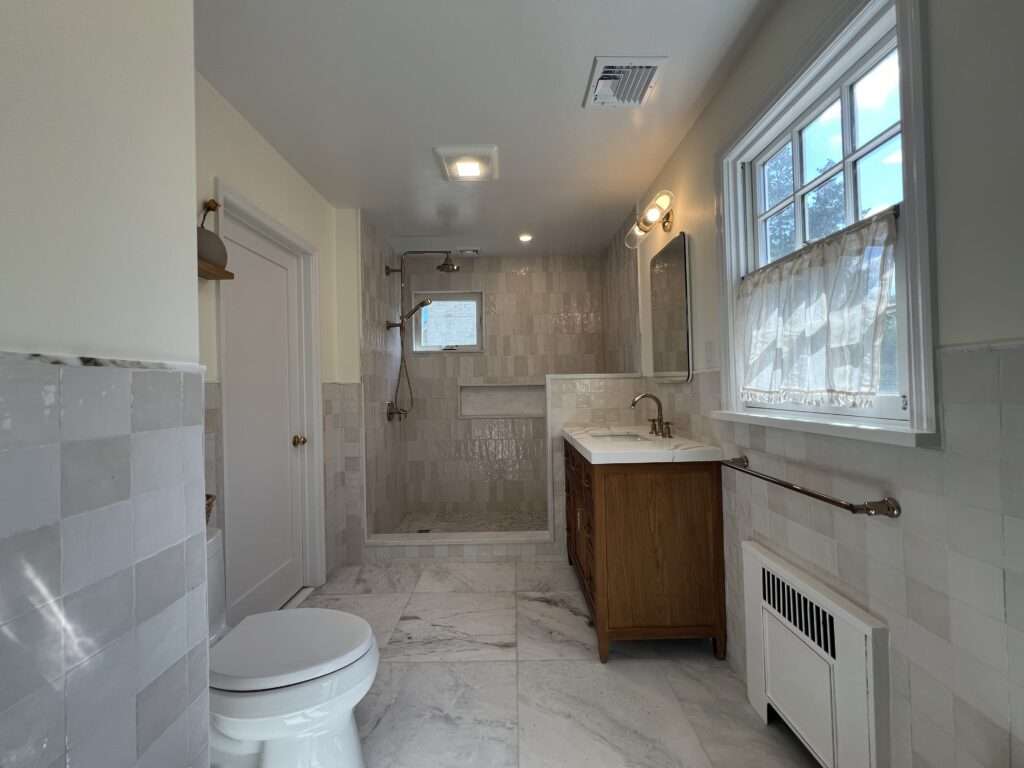
Warm white palettes — featuring soft creams, warm beiges, gentle greiges, and natural unbleached tones — have largely replaced cool whites in current renovations. The shift addresses a common complaint about pure white bathrooms: they read as clinical and unwelcoming despite their cleanliness. Warm whites maintain the brightness and timelessness that drove white bathroom popularity while adding the subtle warmth that creates more inviting daily environments.
Sage and muted green palettes have established themselves as the most significant color trend in New Jersey bathroom renovation. Earthy sage greens, deeper olive tones, and muted forest shades appear regularly in vanity selections, painted accent walls, and tile choices. The popularity reflects broader wellness culture associations with green environments and the color’s flattering effect on skin tones in vanity mirror lighting.
Earthy neutrals — terracottas, warm taupes, mushroom tones, and burnished oranges — appear in supporting roles across many renovations, typically through accent walls, tile selections, or vanity finishes rather than wholesale palette commitment. These warmer earthy palettes work particularly well in homes with significant natural light or those with architectural character that warmer tones complement.
Darker dramatic palettes — deep navy, charcoal, black with brass accents, and rich emerald greens — appear in powder room and guest bathroom renovations more than primary spaces. The dramatic palette approach works well in small spaces that benefit from the cocoon effect of saturated color, and powder rooms provide the perfect venue for design moments that might overwhelm in primary baths used daily.
Material Trends Reshaping Bathroom Surfaces
Material specifications in 2026 New Jersey bathroom renovation reflect significant shifts from work completed even three years ago. Understanding current material directions helps homeowners specify renovations that will read as contemporary for years to come.
Natural Stone Returns to Prominence
After several years of porcelain dominance driven by maintenance considerations and cost advantages, natural stone has returned to substantial prominence in higher-tier renovations. Honed travertine, leathered limestone, soapstone, and book-matched marble slabs appear regularly in current work.
The return of natural stone reflects shifting priorities: homeowners willing to maintain natural materials in exchange for the authentic depth and aging character that stone provides. Sealed properly and treated appropriately, natural stone develops patina that improves with use rather than degrading. Many homeowners now actively prefer this aging quality over the static permanence of porcelain alternatives.
Large-Format Tile and Slab Continues Growth
The trend toward larger tile formats and slab installations continues gaining ground. Where 12×24 inch tiles felt large just a few years ago, 24×48 inch tiles have become standard in current renovations, and 48×96 inch porcelain slabs increasingly appear in shower applications.
The appeal is multifaceted: fewer grout lines mean easier cleaning and more contemporary visual cleanliness, larger formats make small bathrooms feel more spacious, and slab applications eliminate grout lines entirely for visually seamless surfaces. Installation complexity rises with format size, making contractor selection more consequential for these applications.
Zellige and Handmade Tile Surges
On the opposite end of the size spectrum, smaller handmade tiles — particularly zellige tiles from Morocco — have surged in popularity. The irregular surfaces, color variations, and visible maker’s hand provide character and authenticity that machine-made alternatives cannot replicate.
Zellige tiles typically appear in shower walls, vanity backsplashes, and accent installations rather than full coverage. Their slight color variations and surface irregularities create depth that reads as artisanal rather than imperfect, complementing the broader trend toward materials with character and history.
Wood and Wood-Look Surfaces Expand
Wood elements — through actual wood vanities, wood-look porcelain plank flooring, wood ceiling treatments, and wood accent installations — continue expanding across bathroom renovations. The warmth that wood provides addresses the same cultural shift driving color palette changes: bathrooms reading as inviting environments rather than clinical spaces.
Engineered wood vanities and water-resistant wood finishes have matured substantially, allowing genuine wood applications in spaces where moisture concerns previously precluded them. Wood-look porcelain has reached aesthetic quality difficult to distinguish from real wood at normal viewing distance, providing the appearance without maintenance considerations.
Fixture and Finish Directions
Fixture choices reflect both functional priorities and aesthetic directions, and current 2026 work shows distinct patterns across both dimensions.
Aged Brass and Unlacquered Finishes Lead
Aged brass, unlacquered brass, and warm-toned brushed gold finishes have become the most-specified fixture finishes in contemporary New Jersey bathroom renovation. The shift represents movement away from the polished chrome and brushed nickel dominance of previous decades toward warmer, more characterful finishes.
Unlacquered brass — which patinates naturally with use rather than maintaining a perpetually new appearance — particularly appeals to homeowners drawn to material authenticity. The fixture develops character over time rather than degrading, aligning with broader appreciation for materials that age gracefully.
Matte Black Maintains Strong Position
Matte black fixtures have stabilized as a continuing major direction rather than fading as some industry predictions suggested. The finish works across multiple design directions — contemporary, transitional, modern farmhouse, and modern heritage — and provides strong visual definition against most material palettes.
Matte black appears most frequently in faucets, shower fixtures, hardware, light fixtures, and frame treatments. The combination of matte black with warm material palettes (wood vanities, warm white walls, natural stone) creates the contrast and warmth that defines much of current bathroom renovation.
Mixed Metals Become Standard Practice
The rule that finishes must match throughout a bathroom has largely dissolved in contemporary renovation. Current work routinely combines two or three finishes — aged brass faucets with matte black accessories and brushed nickel shower fixtures, for example — in ways that feel intentional rather than chaotic.
Successful mixed-metal applications follow loose principles: one finish typically dominates while others appear in supporting roles, finishes have related warmth characters even when they differ in specific tone, and consistency within fixture categories helps the mixing read as intentional. Contractors and designers experienced with mixed-metal applications guide selection effectively.
Layout and Functional Directions
Beyond aesthetic choices, current renovation work reflects substantial shifts in how bathrooms function and how spaces are organized.
Curbless Showers and Open Designs
Curbless walk-in showers — with linear drains and floor continuity from bathroom to shower — have become standard expectations in primary bathroom renovations and increasingly appear in hall bathroom renovations as well. The visual openness, accessibility benefits, and contemporary aesthetic all drive adoption.
Curbless installations require careful waterproofing and drainage engineering, making contractor selection especially important. Done well, they transform bathroom spatial experience; done poorly, they create persistent moisture problems.
Freestanding Tubs Become Sculptural
Freestanding tubs continue dominating primary bathroom renovations, but the tubs themselves have evolved. Where smooth oval forms defined recent years, current selections include more sculptural shapes — angular forms, asymmetric profiles, stone tubs with sculptural character, and Japanese-inspired soaking tub forms with deeper proportions.
The tubs function increasingly as sculptural objects within bathroom spaces rather than purely utilitarian fixtures, contributing visual weight and design statement that simpler oval profiles couldn’t provide.
Integrated Wellness Features Multiply
Heated flooring, steam showers, chromotherapy lighting, integrated sound systems, smart toilets, and aromatherapy diffusion increasingly appear in renovations across the cost spectrum, not just in luxury work. The cumulative effect transforms bathrooms from functional spaces into integrated wellness environments.
These features add meaningful cost individually but combine to differentiate contemporary renovations from previous-era equivalents. Buyers increasingly notice and value these wellness integrations during home evaluation.
What’s Fading From Contemporary Renovation
Equally instructive as understanding what’s defining current work is understanding what’s actively fading from contemporary renovation. Avoiding these fading directions protects future-proofing.
All-gray palettes that defined renovation work from 2018 through 2022 have begun reading as dated. The cool tones, single-color consistency, and absence of warmth that drove gray’s popularity now feel out of step with broader directional shifts toward warmer, more layered palettes.
Modern farmhouse design, while still popular in many residential contexts, has fundamentally shifted in bathroom applications. Pure modern farmhouse approaches — shiplap walls, barn door entrances, mason jar lighting — increasingly read as dated to current buyers. Selective farmhouse elements (vintage-inspired vanities, traditional subway tile, exposed hardware) continue working when integrated into broader transitional designs.
Brushed nickel fixtures, while not actively disliked, have lost their position as default contemporary specification. Renovations specifying brushed nickel exclusively read as conservative rather than current; warmer or more characterful finishes signal more contemporary work.
Vessel sinks above counters have fallen substantially in popularity after dominating mid-2000s through mid-2010s renovation. Undermount and integrated sinks now dominate, providing easier cleaning, better function, and more contemporary visual cleanliness.
Recessed can lighting as the sole illumination source has given way to layered lighting approaches. Renovations specifying only ceiling cans without complementary task and ambient lighting read as builder-grade rather than considered.
| Apply 2026 Trends Thoughtfully to Your Renovation Speak with our team about your bathroom renovation. We’ll discuss which contemporary directions align with your specific home, your personal aesthetic, and the resale market context. Our team helps balance current trends with long-term durability of design choices. Complimentary in-home consultations across Bergen, Union, Essex, Morris, Passaic, and Somerset counties. ▸ Schedule Your Free Consultation |
Frequently Asked Questions About 2026 Bathroom Trends
Q: Are bathroom trends really shifting quickly, or do they last for years?
Macro directions — natural materials, warmer palettes, layered lighting, integrated wellness — represent durable shifts likely to define renovation work for the next decade or longer. Specific tactical choices within these directions — particular fixture finishes, specific color preferences, particular material selections — evolve more rapidly. Focusing on the macro directions while making considered tactical choices supports long-term satisfaction.
Q: Should I follow trends or choose what I personally love?
The most satisfying renovations balance both. Trends signal directions broader buyer pools find appealing — relevant for resale considerations. Personal preferences ensure daily enjoyment. The best approach typically uses macro trend directions as a framework while making tactical choices that reflect personal taste within that framework.
Q: How do I avoid renovating to a trend that will quickly look dated?
Distinguish macro directional shifts from tactical trend moments. Macro shifts (warm palettes, natural materials, mixed metals) reflect durable changes. Tactical moments (specific signature wallpapers, particular dramatic patterns, specific colored fixtures) often date quickly. Use macro directions broadly, reserve tactical moments for elements that are easily updated.
Q: Are 2026 bathroom trends substantially different in New Jersey versus other regions?
Macro directions align nationally — the warmer palettes, natural materials, and wellness integration patterns appear across regions. Specific tactical preferences vary somewhat regionally. New Jersey work tends to embrace transitional design (bridging contemporary and traditional) more strongly than purely contemporary regions, reflecting the region’s substantial inventory of architecturally characterful homes.