The Small Bathroom Challenge in New Jersey — And Why It Is Solvable
Small bathrooms get a reputation they do not deserve.
Across North and Central New Jersey, the majority of homes — Colonials in Westfield, Cape Cods in Nutley, townhouses in Fort Lee, split-levels in Parsippany — have at least one bathroom under 60 square feet. Many have two or three. These are not architectural failures. They are the natural result of how homes were built in the postwar decades that shaped most NJ neighborhoods.
The problem is not the size. The problem is that most of these bathrooms were designed in an era when renovation was not the point — function was. One overhead light. A pedestal sink. A basic tub/shower combo. Tile that has not been fashionable since 1978.
The good news: in 2026, a skilled contractor working with a well-informed homeowner can make a 5×8 bathroom in Montclair feel genuinely luxurious. Not by magic — by strategy. The right layout decisions, the right tile choices, the right fixtures, and the right storage solutions can transform a cramped, outdated NJ bathroom into a space that feels twice the size and works three times as well.
The Powder Room Guys have completed hundreds of small bathroom renovations across Bergen, Essex, Morris, Union, Passaic, and Somerset Counties. Every project comes with EPA Lead Safe Certified practices (critical in NJ’s older housing stock), full permit management, and Paul’s personal 3-year workmanship warranty. This guide shares exactly what we have learned about making small NJ bathrooms work beautifully.
1. Small Bathroom Challenges Specific to NJ Homes
Not all small bathrooms are created equal. The specific challenges you face depend heavily on when your home was built and what type it is — and North Jersey’s housing stock creates a distinctive set of small bathroom problems.
1.1 Pre-1960 Homes in Summit, Morristown, and Montclair
Essex and Morris County homes from the first half of the 20th century are charming and well-built — but their bathrooms present specific renovation challenges. Cast iron plumbing in aging condition. Single-circuit electrical panels that may not support a modern bathroom’s load. Knob-and-tube wiring in older walls. Original subway tile mortared directly over concrete substrate. And in homes built before 1978: the legal requirement for EPA-certified lead-safe renovation practices.
The Powder Room Guys are EPA Lead Safe Certified specifically to serve this segment of the NJ market. Pre-1978 homes are not a complication to be avoided — they are simply homes that require the proper certified approach.
Additional challenge in historic districts: Morristown, Glen Ridge, Maplewood, and Montclair have local historic preservation ordinances that can affect exterior work and sometimes interior renovations in designated structures. We manage this review process on behalf of homeowners.
1.2 Condos and Townhouses in Bergen County
Bergen County’s condominium and townhouse market — particularly in Fort Lee, Hackensack, Paramus, and Edgewater — presents its own small bathroom renovation constraints. HOA rules govern the scope of plumbing changes. Building management often requires shut-off coordination for shared riser lines. Noise and dust management in multi-unit buildings requires additional planning. And some associations require contractor insurance certificates and board approval before any renovation begins.
The Powder Room Guys are fully versed in Bergen County condo renovation protocols. We handle HOA documentation, building manager coordination, and noise/dust mitigation as standard practice — not as extras.
1.3 Colonial and Cape Cod Homes Across NJ
The most common small bathroom scenario across NJ: a 5×8 hall bathroom in a Center-Hall Colonial or Cape Cod home, typically located off the upstairs hallway and serving multiple bedrooms. These bathrooms were designed for pure utility — and often have not been touched in 20 to 40 years.
Common issues in this profile: galvanized steel supply pipes that have narrowed from mineral buildup, tub surrounds with failed grout behind the wall allowing years of hidden water infiltration, single 15-amp circuits that cannot support today’s bathroom electrical loads, and subfloor damage around the toilet base that is invisible until the toilet is removed.
This is precisely why The Powder Room Guys recommend a full demolition approach for most Colonial-era small bathrooms over 15 years old. A cosmetic overlay conceals problems that compound over time. A proper gut renovation addresses them permanently.
2. Design Strategies for Small NJ Bathrooms
The most important insight in small bathroom design is this: the perception of space is more powerful than the reality of space. A well-designed 5×8 bathroom feels significantly larger than a poorly designed 6×10 one. Here is how Paul and The Powder Room Guys approach small bathroom design in NJ homes.
2.1 Layout Optimization
In a small bathroom, layout is everything — and most small NJ bathrooms have layouts that were not optimised for the space they occupy. The most impactful layout decisions to consider:
- Tub-to-shower conversion: The single most space-liberating change in a small NJ bathroom. A standard 5-foot tub occupies 15 square feet. A 36×36 corner shower occupies just 9 square feet — and feels more spacious because of the open glass enclosure.
- Wall-hung or corner toilet: A wall-hung toilet saves 6–8 inches of depth versus a floor-mount model. In a 5×8 bathroom, that is a meaningful gain. Corner toilets solve the problem of awkward triangular dead zones.
- Door swing reversal: Simply reversing a bathroom door to swing outward — or installing a pocket door or barn door — can recover 8–12 square feet of effective floor space.
- Sink repositioning: Moving a sink 18 inches to optimise the flow pattern between toilet and shower can transform the daily usability of a small bathroom without major structural work.
2.2 Visual Expansion Techniques
These are the design moves that make small NJ bathrooms feel significantly larger than their square footage:
- Large-format tile on the floor: Counter-intuitively, larger tiles (12×24 or larger) make small bathroom floors look bigger — fewer grout lines create a more expansive visual field.
- Vertical tile patterns on walls: Running subway tile vertically, or using tall rectangular tiles, draws the eye upward and makes ceiling height feel greater.
- Continuous tile from floor to ceiling: Eliminating the paint line between the tile zone and the painted zone above creates visual continuity and makes the room feel taller.
- Monochromatic or tonal palettes: A single color family across floor, walls, and fixtures creates visual unity that makes small spaces feel less segmented.
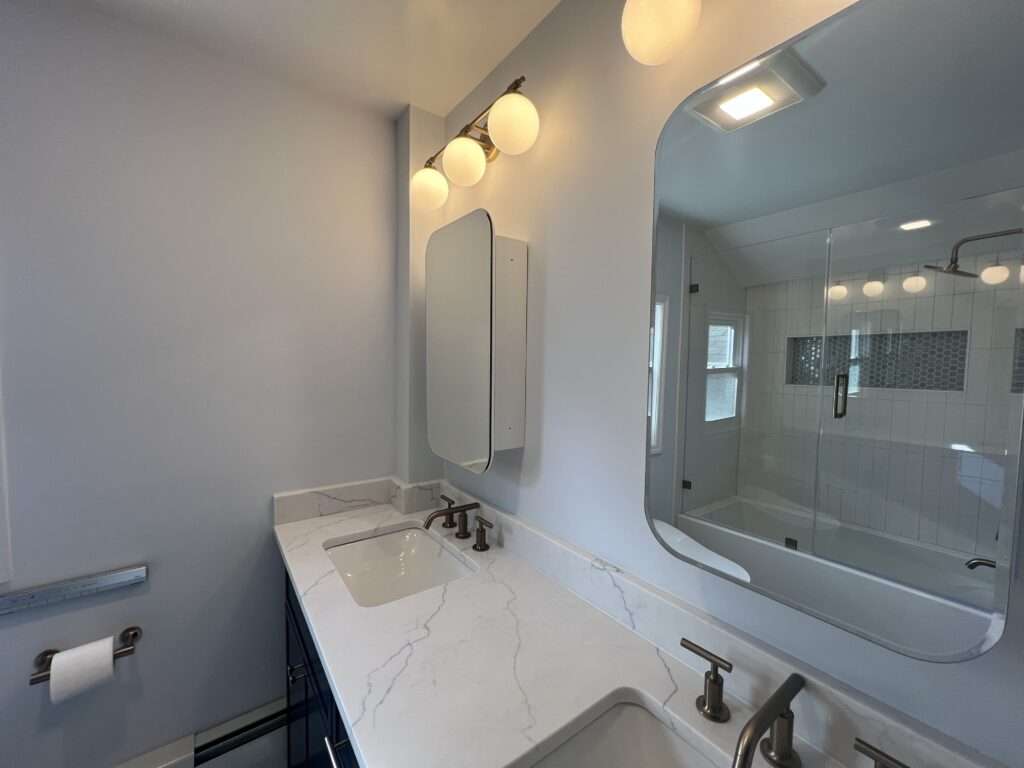
- Frameless glass shower enclosure: The single most effective visual expansion tool in a small bathroom renovation. Frameless glass is transparent — it does not cut the room in two the way a shower curtain or framed glass does.
2.3 Light and Color Choices
Light is the most powerful design tool in a small bathroom — and also one of the most frequently neglected. The standard single overhead light in most NJ Colonial bathrooms creates flat, shadow-heavy illumination that makes small spaces feel gloomy and claustrophobic. Consider:
- Layered lighting: Combine an overhead recessed LED with dedicated vanity side lighting. Side vanity lights eliminate face shadows and make the whole room feel brighter.
- Warm whites (2700K–3000K): This color temperature range makes skin tones look healthy and surfaces look rich. Avoid harsh cool whites (4000K+) in residential bathrooms.
- Light-reflective tile and surfaces: Glossy or semi-gloss tile surfaces bounce light around small rooms. Polished or honed stone and large-format rectified porcelain amplify natural and artificial light.
- Color depth strategy: In very small bathrooms, lighter mid-tones and soft warm neutrals — greige, warm white, soft sage — recede visually. Bold accent colors work best confined to a single feature surface.
2.4 Mirror Strategies
Mirrors are among the most cost-effective design investments in small bathroom renovation. They literally double the perceived depth of any surface they face — and in a small bathroom, that is transformative.
- Full-width vanity mirror: A mirror that runs the full width of the vanity wall (not a small framed piece centered above the sink) can make a small bathroom feel 40% wider.
- Recessed medicine cabinet: Adds storage without projecting into the room — and provides a reflective surface. In a 5×8 bathroom, choosing a recessed medicine cabinet over a surface-mount model recovers 4 inches of room depth.
- Backlit LED mirrors: Combine lighting and reflection in a single fixture. A large backlit LED mirror provides even, flattering light while doubling as the room’s visual anchor.
- Mirror-on-mirror: Facing mirrors — one above the vanity, one on the opposite wall — create an infinity effect that maximises perceived depth. Best used in narrow bathrooms where a sense of width is needed.
3. Storage Solutions for Compact NJ Bathrooms
Storage is consistently cited as the top frustration with small NJ bathrooms — and it is the area where a skilled renovation makes the biggest quality-of-life difference. The key principle: maximise vertical and in-wall storage without projecting into the floor space.
3.1 Built-In Shower Niches
The shower niche is the single highest-value-per-square-inch storage addition in a small bathroom renovation. A properly waterproofed, tiled niche built between studs adds zero floor footprint while providing organised, accessible storage for shampoo, soap, and razors. Paul and The Powder Room Guys install shower niches as standard practice on virtually every shower renovation — the additional cost is minimal (typically $150–$350 in materials and labor) and the functional improvement is significant.
Sizing note: Standard NJ stud spacing of 16 inches on centre creates a natural niche width of approximately 12 inches. Double-stud-bay niches at 24 inches wide require a small header above and are ideal for two-person households.
3.2 Recessed Medicine Cabinets
A recessed medicine cabinet installed between studs provides 3.5–4 inches of depth behind the wall plane — enough for most bathroom toiletries — without consuming any room space. In a 5×8 bathroom, the difference between a surface-mount and a recessed medicine cabinet is the difference between a room that feels tight and one that feels considered.
For older NJ homes: verify stud spacing and check for plumbing or electrical runs behind the installation wall before committing to a recessed approach. The Powder Room Guys assess this during the free consultation.
3.3 Floating Vanities
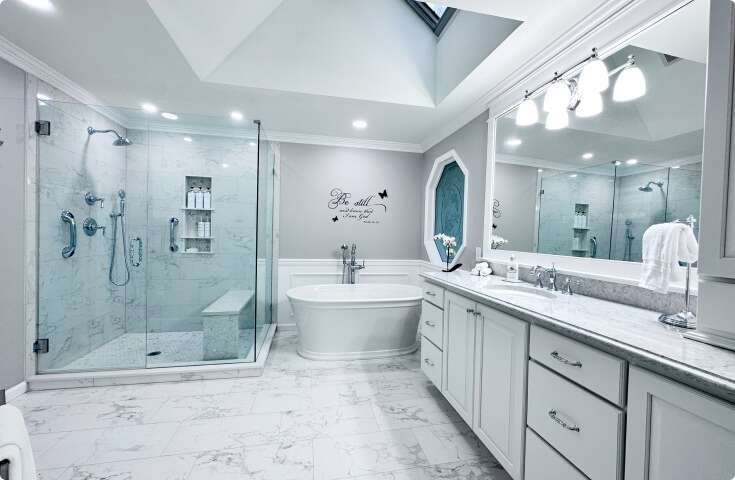
A wall-hung floating vanity accomplishes two things simultaneously: it provides the storage of a standard vanity while leaving the floor plane open beneath it, which creates a sense of more floor area and makes the room easier to clean. Visual floor continuity — tile running uninterrupted beneath the vanity — is one of the most effective spatial expansion techniques available in a small bathroom.
Cost note: floating vanities require proper wall blocking (typically added during rough carpentry at a cost of $200–$400) and careful plumbing rough-in placement. This is not a complication — it simply needs to be planned from the start of the renovation.
3.4 Over-Toilet Storage
The space above the toilet — typically 24 to 36 inches of unused vertical real estate in a 5×8 bathroom — is an opportunity for smart storage. Options range from simple floating shelves ($80–$300) to custom-built over-toilet cabinetry ($600–$1,800). The Powder Room Guys regularly incorporate over-toilet shelving or cabinetry as part of full small bathroom renovations, coordinated with the vanity finish for a built-in look.
3.5 Additional Vertical Storage Strategies
- Tall linen tower: A floor-to-ceiling or ceiling-height linen tower beside the vanity maximises vertical storage while maintaining a minimal floor footprint.
- Corner shelving: Open corner shelving units use dead-zone corners effectively without blocking movement paths.
- Hooks and rails: A high-quality hook rail on the back of the door — or on a wall above the toilet — provides towel and robe storage without consuming shelf or cabinet space.
4. Fixture Selection for Small NJ Bathrooms
In a small bathroom, fixture dimensions are not just specifications — they are spatial decisions. Every inch of toilet projection, vanity depth, and shower enclosure thickness matters at this scale. Here is a guide to the right fixture choices for compact NJ bathrooms.
4.1 Compact and Wall-Hung Toilets
| Toilet Type | Typical Depth | Space Savings vs. Standard | Cost Range | Best For |
| Standard elongated (floor mount) | 28–30″ | Baseline | $200–$900 | Most NJ bathrooms with adequate space |
| Compact elongated (floor mount) | 25–27″ | 2–3″ saved | $250–$1,000 | 5×8 bathrooms with tight layout |
| Round bowl (floor mount) | 25–28″ | 2–4″ vs. elongated | $180–$750 | Smallest layouts; slightly less comfort |
| Wall-hung toilet | 18–20″ (bowl only) | 8–12″ saved + floor clearance | $600–$2,500 + install | Maximum space recovery; excellent for condos |
| Corner toilet | N/A | Fits dead corner space | $300–$900 | L-shaped or irregular small bathrooms |
4.2 Corner Sinks and Narrow Vanities
The sink or vanity is typically the second-largest floor-plan element in a small bathroom after the shower/tub. Choosing the right one can recover 8–15 inches of space.
- Narrow vanities (18–24″ deep): Standard vanities are 21″ deep. Narrow-depth options at 18″ save 3″ — which in a 5×7 bathroom translates to meaningful additional movement clearance.
- Corner sink (pedestal or vanity): Specifically designed for bathrooms where the sink must occupy a corner. Frees the primary wall for other uses — a floating vanity with storage, for example.
- Wall-mount sink: Provides maximum floor visibility and spatial openness. Best used where storage is addressed elsewhere (medicine cabinet, niche, over-toilet unit).
- Vessel sink on shallow shelf: A vessel sink on a thin floating shelf provides maximum visual lightness — particularly effective in bathroom renovations targeting a modern or spa aesthetic.
4.3 Walk-In Shower vs. Tub/Shower Combination
This is the most consequential fixture decision in a small NJ bathroom renovation. The choice depends on three factors: the bathroom’s primary user(s), the home’s resale profile, and the actual square footage available.
| Option | Min. Space Needed | Cost Range | Best For | Resale Note |
| Tub/shower combo (alcove) | 5-ft wall minimum | $1,800–$5,500 | Homes with children; only tub in house | Important to maintain if only tub in home |
| Walk-in shower (corner, 36×36″) | Approx. 9 sq ft | $2,500–$7,000 | Adults, empty nesters, second bathrooms | Very popular with 35–65 NJ buyer demographic |
| Walk-in shower (32×32″ compact) | Approx. 7 sq ft | $2,200–$6,000 | Smallest spaces — en-suites, powder room add-ons | Functional minimum; frameless glass helps |
| Walk-in shower (custom, 36×48″+) | 12+ sq ft | $3,500–$9,500+ | When space permits — the premium choice | High appeal; premium finish potential |
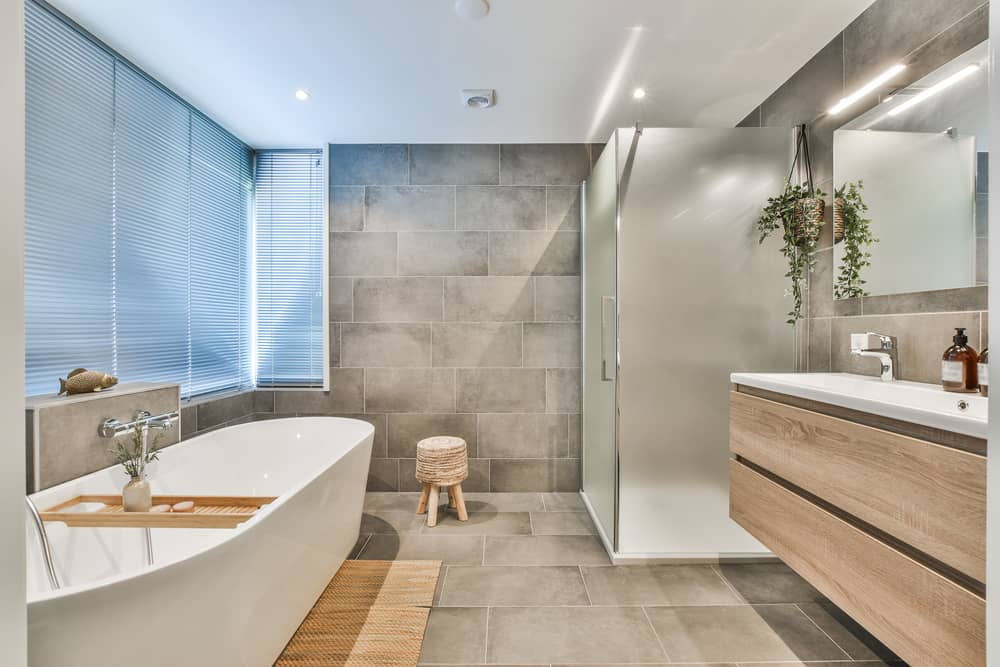
The Powder Room Guys’ recommendation for most small NJ hall bathrooms: if the bathroom is the only full bathroom in the home, maintain the tub/shower in some form. If it is a second or third bathroom, the tub-to-walk-in-shower conversion is almost always the right spatial and lifestyle choice for 2026 NJ buyers and homeowners.
5. Cost Breakdown: Small Bathroom Remodel in NJ
Small bathroom renovations in NJ fall into three distinct tiers — each representing a different combination of scope, material quality, and design aspiration. Here is what each tier actually costs in 2026, based on real Powder Room Guys project data across Bergen, Essex, Morris, Union, Passaic, and Somerset Counties.
5.1 Budget Tier: $8,000–$12,000
The budget-tier small bathroom renovation replaces all visible surfaces and fixtures without structural changes or plumbing relocation. The key constraints: existing plumbing locations stay; existing substrate is reused if sound; and tile installation goes over new cement board without a full gut.
| Cost Item | Budget Range | Notes |
| Demo (partial — tile removal, fixtures) | $600–$1,200 | No structural demolition; substrate stays if sound |
| Tile (floor + shower walls — standard porcelain) | $2,000–$3,500 | Basic to mid-range porcelain; standard install |
| Vanity (stock, 30–36″) | $500–$900 | Home Depot / Lowe’s quality |
| Toilet (standard elongated) | $250–$450 | Kohler Cimarron / American Standard Cadet range |
| Shower fixtures (Moen/Delta entry-level) | $300–$600 | Basic pressure-balance valve + showerhead |
| Exhaust fan + light (basic) | $150–$350 | Code-required; basic Broan or Panasonic |
| Labor (tile, plumbing, electrical, GC) | $2,800–$4,200 | Proportionally lower than mid/high tiers |
| Permits | $300–$500 | Required for all plumbing + electrical work in NJ |
| TOTAL | $8,000–$12,000 | Budget tier — cosmetic transformation |
5.2 Mid-Range Full Remodel: $12,000–$18,000
The mid-range full remodel is the most popular tier for small NJ bathroom renovation — and The Powder Room Guys’ core service offering. Full demolition to the studs. New waterproofing membrane. All-new plumbing rough-in (same wall locations, new supply and drain runs). Code-compliant electrical. Quality materials throughout.
| Cost Item | Mid-Range Cost | Notes |
| Full demolition (to studs) | $1,200–$1,800 | Complete gut — all tile, substrate, fixtures removed |
| Waterproofing membrane (Schluter Kerdi) | $600–$1,000 | Critical for long-term performance; non-negotiable |
| Tile — floor (12×24 porcelain) | $800–$1,400 | Quality porcelain; includes labor |
| Tile — shower walls (large-format) | $1,800–$3,200 | Full height; large-format adds labor complexity |
| Shower niche (built-in) | $250–$450 | Included as standard in TPR Guy renovations |
| Frameless or semi-frameless glass | $1,200–$2,200 | Major visual upgrade vs. curtain or framed door |
| Vanity (semi-custom, 30–42″) | $900–$2,200 | Better construction; more style options |
| Toilet (Kohler / Toto mid-range) | $450–$900 | Significant quality and comfort step up |
| Shower system (Kohler/Moen thermostatic) | $600–$1,400 | Handheld + fixed head combo popular in NJ |
| Exhaust fan (Panasonic WhisperCeiling) | $300–$500 | Quiet, code-compliant, longevity-focused |
| Heated floor mat (electric) | $450–$900 | Popular in NJ — adds significant daily luxury |
| Electrical (GFCI + new circuits) | $700–$1,200 | NJ code: GFCI protection required near water |
| Labor (all trades, GC management) | $3,500–$5,500 | Reflects NJ licensed trade rates |
| Permits + inspections | $400–$650 | Full NJ UCC permit set |
| TOTAL | $12,000–$18,000 | Mid-range full gut — genuine transformation |
5.3 High-End Transformation: $18,000–$28,000
The high-end small bathroom renovation makes no compromises. Premium imported tile. Custom-sized frameless glass. Designer fixtures from Hansgrohe, Grohe, or AXOR. Custom millwork vanity built to exact dimensions. Heated floor and walls in premium markets. This tier is increasingly common in Bergen County and the Summit/Chatham/Westfield corridor.
| Cost Item | High-End Cost | Notes |
| Full demolition + structural review | $1,800–$2,800 | May include limited structural changes |
| Premium waterproofing (full system) | $900–$1,400 | Schluter KERDI-BOARD system or equivalent |
| Premium tile — floor (natural stone or large-format) | $1,800–$4,500 | Italian porcelain, marble, or travertine |
| Premium tile — walls (floor-to-ceiling) | $3,500–$7,000 | Large-format; complex pattern; full height |
| Custom frameless glass enclosure | $2,200–$4,000 | Bespoke sizing; low-iron glass option |
| Custom vanity (built-to-spec) | $2,500–$6,000 | Exact dimensions; premium wood; soft-close |
| Premium toilet (Toto Neorest / KOHLER Numi) | $900–$4,500 | Smart bidet functionality; very popular in NJ |
| Designer shower system (Hansgrohe/Grohe) | $1,400–$4,500 | Thermostatic; multi-function; ceiling mount |
| Heated floor (full electric system) | $800–$1,400 | Nuheat or Schluter DITRA-HEAT |
| Backlit LED mirror | $400–$1,200 | Functional and aesthetic centrepiece |
| Specialty lighting (layered) | $600–$1,400 | Recessed LED + vanity side lights |
| Premium exhaust (Panasonic / Broan Sensaire) | $500–$900 | Humidity sensing; timed operation |
| Labor (all trades + design-build management) | $4,500–$7,000 | Premium NJ contractor rates + PM overhead |
| Permits + inspections | $450–$700 | Full NJ UCC permit set |
| TOTAL | $18,000–$28,000 | High-end transformation — best of NJ craftsmanship |
6. Before & After: Real NJ Small Bathroom Transformations
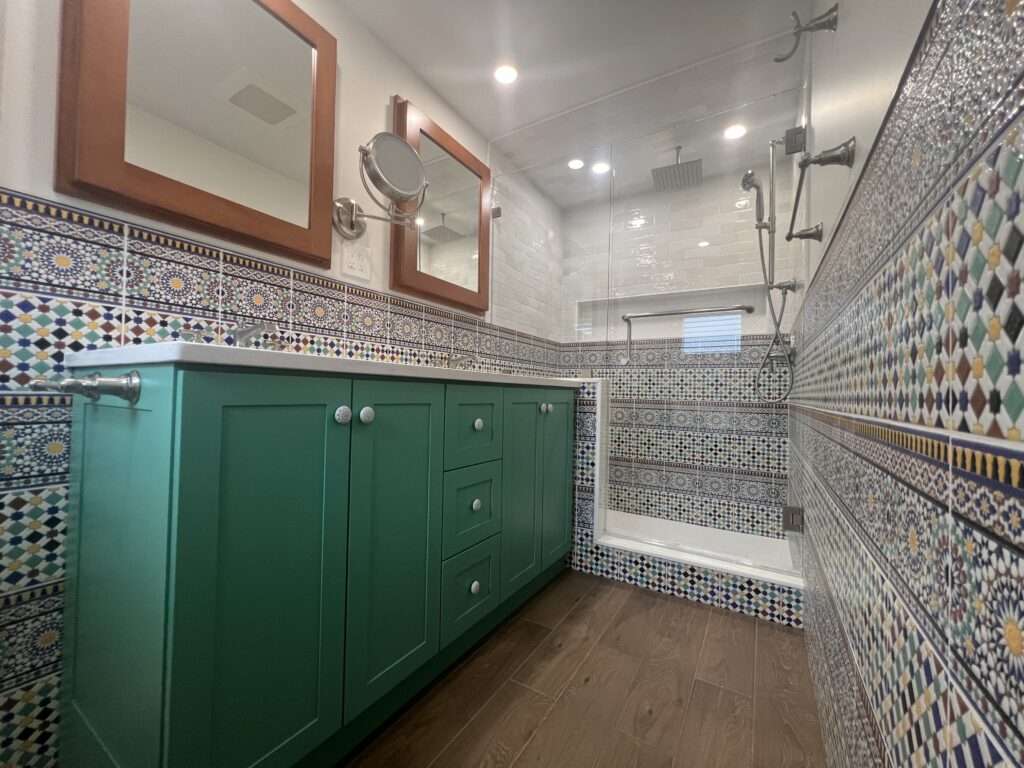
The best way to understand what is possible in a small NJ bathroom is to see what has actually been done. Here are three real projects from The Powder Room Guys across Essex, Union, and Morris Counties.
| 🏠 BEFORE & AFTER: 5×8 Bathroom in Montclair, Essex County Project size: 5×8 ft (40 sq ft) — primary hall bath, 1958 Colonial Scope: Full demolition remodel — mid-range tier Total cost: $15,200 Before: Original 1958 pink and grey ceramic tile floor-to-ceiling. Cast iron tub with 1980s fiberglass surround. Single 40W ceiling light. No exhaust fan. Surface-mount medicine cabinet. Galvanized supply pipe (replaced during renovation). After: Tub-to-shower conversion. Large-format soft white porcelain tile floor-to-ceiling with horizontal grey accent stripe. Frameless glass shower door. Compact floating vanity (24″) with integrated storage. Recessed medicine cabinet. Kohler Cimarron toilet. Panasonic WhisperCeiling exhaust fan. Nuheat electric floor mat. LED recessed ceiling light + LED vanity side lights. Timeline: 12 working days on-site | 7 weeks total (permit processing) Hidden cost found: Galvanized supply pipe — replaced: $1,400 (included in final total above) “The difference is unbelievable. Same square footage — it feels like a completely different home. Paul found the galvanized pipe during demo and explained exactly what needed to happen. No surprises, no drama.” — Homeowner, Montclair |
| 🏠 BEFORE & AFTER: 6×7 Bathroom in Summit, Union County Project size: 6×7 ft (42 sq ft) — second full bath, 1975 Colonial Scope: Full demolition remodel — high-end tier Total cost: $22,800 Before: Original 1975 avocado green tile. Tub/shower with cracked grout and suspected mold behind wall. Plastic vanity. Builder-grade toilet. Zero storage. Single surface-mount light bar. After: Walk-in shower (36×36 corner) with floor-to-ceiling Carrara-look large-format porcelain. Custom 30″ floating vanity (navy, quartz top). Kohler Wellworth comfort-height toilet. Backlit LED mirror (full-width, 30″). Heated floor (Nuheat mat, 35 sq ft). Recessed medicine cabinet. Recessed LED downlight + LED vanity side lights. Moen Genta shower system with hand shower. Timeline: 13 working days on-site | 9 weeks total (custom vanity lead time) Hidden cost found: Mold remediation behind tub wall — $1,200 (included in final total above) “Summit is a competitive market. Paul told us upfront that a well-executed second bathroom renovation would add more to our value than the cost. He was right. We got an unsolicited offer on the house eight months later — the buyers specifically mentioned both bathrooms.” — Homeowner, Summit |
| 🏠 BEFORE & AFTER: 5×10 Bathroom in Westfield, Union County Project size: 5×10 ft (50 sq ft) — master en-suite, 2001 Colonial Scope: Mid-range full remodel — bathroom shared between master and bedroom Total cost: $17,600 Before: Builder-grade 2001 installation: white 4×4 wall tile, beige floor tile, single vanity (24″), basic tub/shower, no storage. Outdated but structurally sound. After: Tub retained (home’s only tub) — tub surround fully retiled with large-format stone-look porcelain to ceiling. Shower area separated with frameless glass panel. New semi-custom double vanity (48″ — fit possible due to 10-ft dimension). Two recessed medicine cabinets. Heated floor. New Moen Genta fixtures throughout. Kohler Santa Rosa elongated toilet. Dual recessed LEDs + vanity side lights. Timeline: 11 working days on-site | 8 weeks total Hidden cost found: None — structurally clean 2001 home “We kept the tub because we have young kids. But the rest of the bathroom is completely transformed. Having a double vanity in a 5×10 bathroom sounds impossible — Paul made it work perfectly. The heated floor was the best decision we made.” — Homeowner, Westfield |
7. Common Mistakes to Avoid in NJ Small Bathroom Renovations
After hundreds of small bathroom renovations across North Jersey, here are the mistakes Paul sees homeowners and contractors make — and how to avoid them.
| Mistake | Why It Happens | Consequence | How to Avoid |
| Tiling over existing tile | Seems like a money-saver | Adds weight, masks hidden moisture damage, produces hollow spots | Always gut to studs — inspect substrate before tiling over anything |
| Choosing a vanity that is too large | Showroom looks spacious | Blocks door swing, creates cramped daily use | Measure twice: door swing, traffic path, toilet clearance all matter |
| Skipping permits | Faster and cheaper short-term | Unpermitted work = insurance liability + sale disclosure nightmare | All NJ plumbing/electrical work legally requires permits — always |
| Ignoring the ceiling height opportunity | Focus stays low | Missed vertical storage and visual expansion potential | Floor-to-ceiling tile and tall cabinets transform perceived size |
| Shower curtain over frameless glass | Lower upfront cost | Visual divider makes small room feel smaller | Frameless glass is the highest-ROI upgrade in a small bathroom |
| Cutting corners on waterproofing | Saves $400–$600 | Water damage, mold, structural failure within 3–7 years | Proper waterproofing membrane (Schluter KERDI or equivalent) is non-negotiable |
| Matching everything exactly | Feels safe | Flat, characterless result — the ‘hotel bathroom’ look | Contrast: one dark or bold element (vanity colour, floor tile) elevates the whole room |
| Under-specifying lighting | Lights are an afterthought | Flat overhead-only light makes small rooms feel smaller and gloomy | Layer lighting: recessed ceiling + vanity side lights at minimum |
8. Timeline for Small NJ Bathroom Remodels
One of the most common questions Paul hears: how long will we be without a bathroom? Here is the full realistic timeline for a small NJ bathroom renovation — from initial consultation through final punch-list.
| Phase | Duration | What Happens |
| Free consultation + estimate | 1–2 days after contact | Paul visits, assesses space, discusses goals and scope |
| Proposal + contract signing | 3–5 days after consultation | Written proposal, itemised scope, payment schedule |
| Material selection | 1–3 weeks | Tile, vanity, fixtures, hardware — The Powder Room Guys app tracks selections |
| Permit application submission | Day 1 of project process | Plumbing, electrical, building permits filed with your municipality |
| Permit processing (NJ) | 1–4 weeks depending on county | Bergen and Essex can run longer; Somerset and Union typically faster |
| Material ordering + lead time | 2–6 weeks (parallel with permits) | Standard materials: 2 weeks. Custom vanity: 4–8 weeks. Special-order tile: 3–6 weeks. |
| Demo day through rough-in | Days 1–4 on-site | Full demolition, waterproofing, plumbing rough-in, electrical rough-in |
| Inspections (rough-in) | Day 4–5 | NJ inspector visits for rough plumbing and electrical sign-off |
| Tile installation | Days 5–9 on-site | Floor and wall tile set, grouted, cured |
| Fixture installation + finish work | Days 9–12 on-site | Vanity, toilet, shower fixtures, glass, mirror, lighting, accessories |
| Final inspection | Day 12–14 | NJ building inspector final sign-off — The Powder Room Guys manage this |
| Punch-list + touch-up | Day 14–15 | Final walkthrough with homeowner; any items addressed |
| TOTAL TIMELINE | 7–11 weeks | Most time: permit processing + material lead time (not on-site work) |
| 🕐 Realistic Expectation Note The 10–15 working days of on-site construction for a small NJ bathroom renovation is genuinely manageable — most households can use another bathroom or gym facilities during this period. The total 7–11 week timeline is dominated by permit processing and material ordering, not construction time. The Powder Room Guys provide a project management app with daily photo updates and milestone tracking — homeowners always know exactly where their project stands. Permit processing times vary significantly by NJ municipality. Bergen County (70 separate jurisdictions) can run slower than Somerset or Morris Counties. We factor expected permit timelines into your project schedule from day one. |
Frequently Asked Questions: Small Bathroom Remodels in NJ
| [Developer: FAQPage schema applies to all Q&As in this section] |
What is the minimum size for a walk-in shower in a small NJ bathroom?
The minimum comfortable walk-in shower size is 36×36 inches (9 square feet). A 32×32 inch shower is the functional code minimum and works in the tightest spaces but feels small in daily use. For small NJ bathrooms with a tub-to-shower conversion, The Powder Room Guys typically recommend 36×48 or larger if the layout allows — the additional square footage dramatically improves the daily shower experience.
Is it worth remodeling a small bathroom in NJ?
Yes — consistently and measurably. A well-executed small bathroom renovation in North Jersey delivers 120–140% ROI on average, and dramatically reduces days on market at sale. For homes with only one or two bathrooms, an outdated bathroom is one of the most powerful negative factors in buyer perception and offer price. Conversely, a renovated bathroom — even a small one — sends a strong signal of property care that supports premium pricing.
Can I add a walk-in shower to a 5×8 bathroom?
Yes. A 5×8 bathroom is the most common small bathroom in North Jersey and a very achievable space for a tub-to-shower conversion. With a 36×36 corner shower and frameless glass door, a properly designed 5×8 bathroom can feel genuinely spacious. The Powder Room Guys have completed dozens of 5×8 tub-to-shower conversions across NJ — it is one of their most requested small bathroom projects.
How much does a tub-to-shower conversion cost in NJ?
A tub-to-shower conversion in a small NJ bathroom costs $8,500–$14,000 for a mid-range approach (new shower pan, tile, frameless door, updated plumbing) and $14,000–$20,000 for a premium conversion with large-format tile, custom glass enclosure, and designer fixtures. This is typically included within the overall bathroom renovation cost rather than quoted as a separate item.
Do I need a permit to remodel a small bathroom in NJ?
Yes — any bathroom renovation involving plumbing changes, electrical work, or structural modifications requires permits under New Jersey’s Uniform Construction Code (UCC). Permits must be pulled by a licensed NJ contractor and filed with your municipality’s Construction Office. The Powder Room Guys manage all permit applications and inspections as part of every project.
How long does a small bathroom remodel take in NJ?
On-site construction for a small NJ bathroom renovation takes 10–15 working days for a full demolition remodel. Total project timeline — including permit processing and material lead time — is typically 7–11 weeks. The Powder Room Guys provide daily photo updates through a dedicated project management app so homeowners always know exactly what is happening.
Ready to Transform Your Small NJ Bathroom? Three Ways to Get Started
Small bathrooms are not limitations. In the right hands, they are opportunities — to demonstrate precisely what exceptional design and craftsmanship can accomplish within constraints. The Powder Room Guys have made beautiful bathrooms out of 40-square-foot spaces. The result is always worth it.
The first step is a conversation. Paul and his team offer a free consultation — either virtual (photos + measurements) or in-person — for all homes across Bergen, Essex, Morris, Union, Passaic, and Somerset Counties.
| 📞 Get Your Free Small Bathroom Consultation Option 1: Free Design Consultation — Send photos of your existing bathroom and we will provide preliminary design guidance and ballpark pricing within 48 hours. Option 2: Free In-Home Estimate — Paul visits your home, measures the space, and provides a detailed written proposal. Option 3: Small Bathroom Portfolio Review — See 20+ before/after small bathroom transformations from across NJ on our website. Phone: (800) 714-6949 Email: info@thepowderroomguys.com Website: thepowderroomguys.com Hours: Monday–Friday, 9:00 AM – 6:00 PM |