| 🔑 Key Takeaways You can safely DIY cosmetic bathroom tasks: painting, hardware, mirrors, accessories, and sometimes fixtures.Leave waterproofing, plumbing, electrical, wet-area tile, and permit work to licensed NJ pros.A hybrid approach — DIY the finishes, hire pros for the technical work — often delivers the best value.DIY savings are real on cosmetic work but can evaporate on complex tasks once mistakes and tools are counted.In NJ, plumbing and electrical work often legally require licensed professionals. |
The appeal of a DIY bathroom renovation is obvious: save on labor, take pride in the work, and control every detail. And in New Jersey, where labor rates are high, the potential savings are real. But the bathroom is also the hardest room in your home to get wrong: behind those walls are plumbing, electrical, and waterproofing systems where one mistake can lead to leaks, mold, failed inspections, and repairs costing thousands.
So the smart question isn’t ‘DIY or hire a pro?’ — it’s ‘which parts should I DIY, and which should I leave to professionals?’ This honest guide answers exactly that. We’ll show you what you can confidently do yourself, what you should never DIY in NJ, the real cost savings, a step-by-step overview, and how a hybrid approach often delivers the best of both worlds. Confident DIYer in Toms River or first-timer in Montclair, this is how to approach the work the smart way.
| ⚡ Quick Answer: Can I renovate a bathroom myself in NJ? You can DIY the cosmetic parts of a bathroom renovation in NJ — painting, hardware swaps, mirror and accessory installation, and sometimes faucet or toilet replacement. However, waterproofing, plumbing relocation, electrical work, wet-area tile, and any work requiring a permit should be done by licensed professionals to avoid costly damage and code violations. |
What Can You Safely DIY in a Bathroom?
These tasks are low-risk, reversible, and genuinely money-saving for handy NJ homeowners. If you’re comfortable with basic tools and willing to learn, you can tackle:
Painting
Painting walls and ceiling is the most beginner-friendly, high-impact DIY task. Use moisture-resistant bathroom paint in a satin or semi-gloss finish that resists humidity and wipes clean. Proper prep — cleaning, patching, and priming — makes the difference between an amateur and professional-looking result.
Hardware & Accessory Swaps
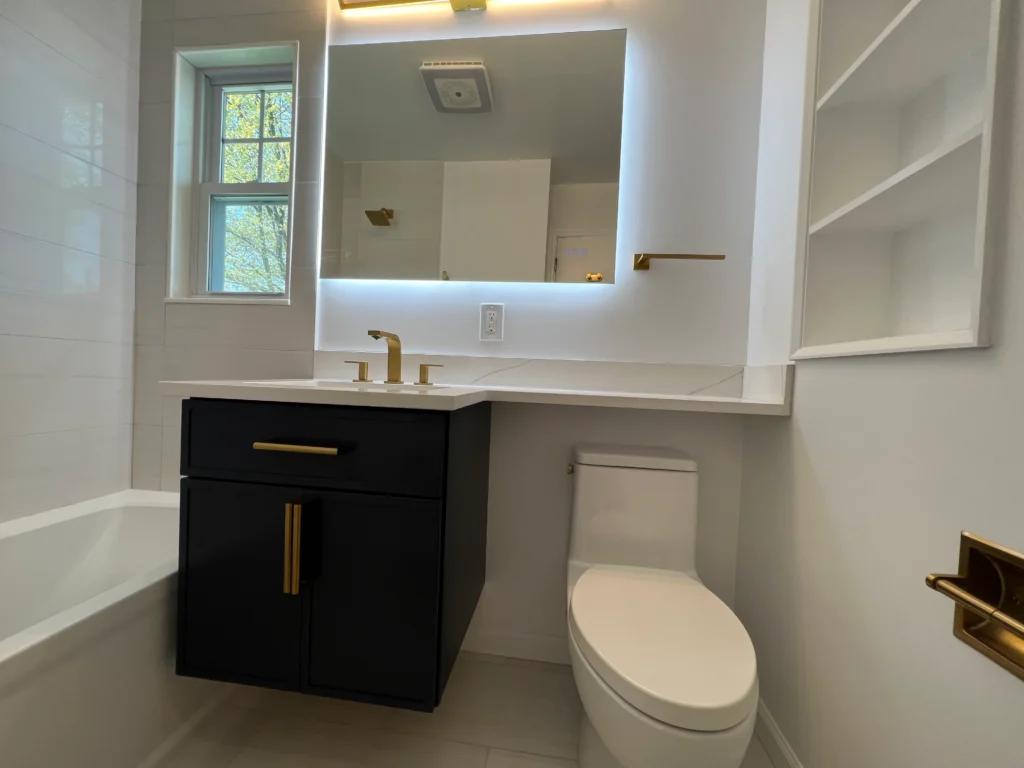
Replacing towel bars, robe hooks, drawer pulls, the toilet paper holder, and other hardware is simple, cheap, and transformative. Coordinated warm-metal or matte-black hardware modernizes a bathroom for a couple hundred dollars and an afternoon’s work.
Mirror Replacement
Swapping a builder-grade mirror for a framed, arched, or backlit mirror is a straightforward DIY that noticeably upgrades the vanity area. Just be sure to anchor it securely.
Caulking Refresh
Removing old, discolored caulk and applying fresh caulk around the tub, sink, and backsplash is a cheap, satisfying DIY that makes a bathroom look instantly cleaner. Use a quality mildew-resistant silicone caulk.
Faucet Replacement
Replacing a faucet is a moderate-skill DIY for confident homeowners — it involves shutting off the water, disconnecting supply lines, and installing the new fixture. Manageable if you’re careful, though a pro is wise if you’re unsure.
Toilet Replacement
Swapping a toilet (same location, same rough-in) is a moderate DIY task. It’s heavy and requires care with the wax ring and connections, but it’s achievable for a handy homeowner following the toilet’s instructions.
Accessories & Styling
Adding shelving, art, plants, baskets, and rugs is pure cosmetic DIY that personalizes the space with zero risk.
What Should You NEVER DIY in a Bathroom?
| ⚡ Quick Answer: What bathroom work should not be done DIY? Never DIY waterproofing, plumbing relocation, electrical work, wet-area (shower) tile, or any work requiring a permit. These tasks carry serious risk of water damage, code violations, and safety hazards, and NJ law requires licensed professionals for much plumbing and electrical work. DIY mistakes here often cost thousands to fix. |
These tasks carry serious risk, are often legally regulated in NJ, and are where DIY mistakes become five-figure repairs. Leave them to licensed professionals:
Waterproofing (The #1 Never-DIY)
This is the single most important reason to hire a pro. Tile and grout are not waterproof — a proper waterproofing membrane system behind them is what keeps water out of your walls and subfloor. DIY waterproofing failures cause hidden leaks, mold, and rot, with repairs running $4,000–$8,000 or more. There is zero margin for error, and the failure is invisible until it’s a disaster.
Plumbing Relocation
Moving a drain, relocating supply lines, or repiping is skilled work. Mistakes cause leaks behind finished walls, drainage problems, and code violations. In NJ, significant plumbing work legally requires a licensed plumber.
Electrical Work
Bathrooms require GFCI protection, proper exhaust fan wiring, and code-compliant lighting circuits. DIY electrical mistakes create fire and shock hazards, and NJ code requires licensed electrical work in many cases. With water and electricity in the same room, this is not the place to experiment.
Wet-Area / Shower Tile
Floor tile in a dry area can be a DIY project for a skilled homeowner, but shower and wet-area tile must be set over proper waterproofing and backer board with correct slope to the drain. DIY shower tile that looks fine often fails within 1–2 years, requiring a full tear-out and redo.
Anything Requiring a Permit
The NJ Uniform Construction Code requires permits for plumbing, electrical, and structural bathroom work. DIY work without permits can void your homeowner’s insurance, fail at resale inspection, and require expensive corrections. Licensed contractors pull and pass these permits routinely.
| Need a Pro for the High-Risk Work? Free in-home estimate — DIY the finishes, let us handle the rest. No pressure, no obligation. 📞 (800) 714-6949 | thepowderroomguys.com → Get Your Free Bathroom Estimate |
DIY Bathroom Renovation: Real Cost Savings
How much does DIY actually save? Here’s an honest comparison for common NJ bathroom tasks:
| Task | DIY Cost | Pro Cost | Verdict |
| Paint & hardware | $300–$800 | $1,500–$3,000 | DIY wins big |
| Mirror & accessories | $150–$600 | $500–$1,200 | DIY wins |
| Faucet / toilet swap | $300–$900 | $800–$2,000 | DIY if confident |
| Floor tile (dry area) | $800–$2,000 | $2,500–$5,000 | Risky DIY |
| Shower tile + waterproofing | $1,500–$3,500 | $5,000–$9,000 | Hire a pro |
| Full renovation | $8,000–$15,000* | $22,000–$32,000 | Hire a pro |
*The DIY full-renovation figure assumes nothing goes wrong — which, with plumbing and waterproofing involved, it often does. Factor in tool purchases, mistakes, rework, and your time.
The pattern is clear: DIY delivers real, substantial savings on cosmetic tasks, but the savings shrink or vanish on complex technical work once you account for tools, mistakes, rework, and the value of your time. A DIY waterproofing failure alone can cost more than you’d have saved on the entire project.
The Hidden Costs of DIY Nobody Mentions
- Tool purchases — a proper tile job needs a wet saw, trowels, levels, and mixing tools (hundreds of dollars)
- Time — a pro crew finishes in weeks what takes a DIYer months of weekends
- Mistakes and rework — DIY errors often cost more to fix than hiring a pro would have cost originally
- No warranty — DIY work carries no workmanship warranty; pros stand behind their work
- Resale risk — unpermitted or visibly amateur work hurts your home’s value and can derail a sale
- Living without a bathroom longer — DIY timelines stretch, leaving you without a functional bathroom for weeks or months
- Safety risk — plumbing and electrical mistakes create water damage, fire, and shock hazards
None of this means DIY is a bad idea — it means DIY is a great idea for the right tasks and a costly one for the wrong tasks.
The Smart Hybrid Approach
For most NJ homeowners, the best DIY bathroom renovation isn’t fully DIY — it’s a hybrid. You handle the cosmetic, low-risk, high-satisfaction tasks (painting, hardware, mirror, accessories, and cosmetic prep), and you hire licensed professionals for the structural, plumbing, electrical, waterproofing, and wet-area tile work that makes or breaks the bathroom. This approach captures real savings where it’s safe, protects your home where it counts, and delivers a result that looks and lasts like a professional job. Many NJ homeowners save meaningfully by doing demolition prep and all the finishing touches themselves while leaving the technical core to a bathroom specialist.
DIY-Friendly Step-by-Step Overview
If you’re planning a hybrid DIY renovation, this is the general sequence and where DIY fits:
- Plan and budget — decide your scope, set a budget, and honestly assess which tasks you’ll DIY.
- Design and select materials — choose tile, vanity, fixtures, and finishes (a fun DIY-friendly phase).
- Hire pros for the technical work — line up licensed plumbing, electrical, waterproofing, and tile.
- Obtain permits — your licensed contractor handles these for the regulated work.
- Demolition — you can often DIY basic demo and cleanup to save labor (carefully).
- Rough-in (pro) — plumbing and electrical rough-ins, then inspection.
- Waterproofing and tile (pro for wet areas) — the critical hidden work.
- Fixtures and finishing — install vanity, toilet, faucet (DIY-able), then your DIY finishing: paint, hardware, mirror, accessories.
- Final inspection and enjoy — the regulated work passes inspection and you enjoy the savings of your DIY contributions.
This sequence lets you contribute meaningfully and save money without gambling on the high-risk work.
How to Decide: DIY or Hire?
For each task, ask yourself these honest questions:
- Does it involve plumbing, electrical, or waterproofing? If yes → hire a pro.
- Does it require a permit in NJ? If yes → hire a pro.
- Is it hidden behind a wall or under tile? If yes → hire a pro (mistakes are invisible until they’re disasters).
- Is it cosmetic and reversible? If yes → DIY is a great money-saver.
- Do you have the tools, time, and genuine skill? Be honest — a half-finished bathroom is worse than not starting.
When in doubt on anything touching water or wiring, hire a pro. The bathroom is not the room to learn expensive lessons.
A Realistic Look at DIY Skill Levels
Not every DIYer is the same, and being honest about your own skill level saves a lot of grief. Here’s a fair way to think about it.
The Beginner
If you’ve painted a room and swapped out a light switch, you’re a beginner. Stick to painting, hardware, mirrors, accessories, and caulking. These give you a real sense of accomplishment and a noticeably fresher bathroom, with essentially no risk. Leave everything with water or wiring to the pros. There’s no shame in this; a beautifully painted, freshly accessorized bathroom is a genuine improvement.
The Intermediate DIYer
If you’ve hung drywall, replaced a faucet, or installed a toilet successfully, you can take on a bit more: faucet and toilet swaps in the same location, simple dry-area flooring, and demolition. You still want a licensed pro for plumbing relocation, electrical, waterproofing, and shower tile. The intermediate sweet spot is doing the demo and the finishing while the pros handle the technical core.
The Advanced DIYer
If you’ve done real tile work, understand waterproofing systems, and have the right tools, you can tackle dry-area tile and some tile confidently. Even so, most advanced DIYers in NJ still hire out the plumbing and electrical, both because of the code requirements and because a permit inspection expects licensed work. Know your limits honestly; the cost of overreaching in a bathroom is measured in thousands, not hundreds.
What a DIY Mistake Actually Costs
It helps to see why the never-DIY list is what it is. A few real-world examples of how a small saving turns into a big bill:
- Failed shower waterproofing: The tile looks perfect for a year, then water seeping behind it rots the subfloor and wall framing. The fix is a full tear-out and rebuild, often $5,000 to $9,000, plus any mold remediation.
- A hidden plumbing leak: A joint that wasn’t sealed properly drips inside a finished wall for months. By the time you see the stain, you’re repairing drywall, framing, and possibly the ceiling below.
- An electrical shortcut: Skipping GFCI protection or overloading a circuit isn’t just a code violation, it’s a genuine shock and fire risk in a wet room, and it will fail inspection.
- Unpermitted work: It passes unnoticed until you try to sell, when the buyer’s inspector flags it and the sale stalls while you pay to bring it up to code retroactively.
The pattern is always the same: the DIY task that goes wrong is the hidden one, and hidden mistakes are the expensive ones. That’s the whole logic behind DIYing the visible finishes and hiring out the rest.
DIY Bathroom Renovation NJ — Frequently Asked Questions
Can I renovate a bathroom myself in NJ?
You can DIY the cosmetic parts of a bathroom renovation in NJ — painting, hardware swaps, mirror and accessory installation, and sometimes faucet or toilet replacement. However, waterproofing, plumbing relocation, electrical work, wet-area tile, and any work requiring a permit should be left to licensed professionals to avoid costly damage and code violations.
What bathroom work should not be done DIY?
Never DIY waterproofing, plumbing relocation, electrical work, wet-area (shower) tile, or any work requiring a permit. These carry serious risk of water damage, code violations, and safety hazards, and NJ law requires licensed professionals for much plumbing and electrical work. DIY mistakes here often cost thousands to fix.
How much can I save with a DIY bathroom renovation?
DIY delivers real savings on cosmetic tasks — a paint-and-hardware refresh might cost $300–$800 DIY versus $1,500–$3,000 for a pro. However, savings shrink or vanish on complex technical work once you account for tools, mistakes, rework, and your time. A DIY waterproofing failure alone can cost $4,000–$8,000 to fix.
What is the most dangerous bathroom task to DIY?
Waterproofing is the most dangerous bathroom task to DIY. Tile and grout aren’t waterproof — a proper membrane system behind them is what prevents water from destroying your walls and subfloor. DIY waterproofing failures cause hidden leaks and mold, with repairs running thousands, and the failure is invisible until it’s a disaster.
Can I DIY bathroom tile?
You can DIY floor tile in a dry area if you’re skilled and patient. However, shower and wet-area tile should be left to professionals — it must be set over proper waterproofing and backer board with correct slope to the drain. DIY shower tile commonly fails within 1–2 years, requiring a full tear-out and redo.
Do I need a permit for a DIY bathroom renovation in NJ?
Yes, if your DIY renovation involves plumbing, electrical, or structural changes — the NJ Uniform Construction Code requires permits regardless of who does the work. Purely cosmetic DIY (paint, hardware, mirror) generally doesn’t. Unpermitted regulated work can void insurance and derail a home sale, so permit anything that legally requires it.
What is the best approach to a DIY bathroom renovation?
The best approach is a hybrid: DIY the cosmetic, low-risk tasks (painting, hardware, mirror, accessories, cosmetic prep) and hire licensed professionals for the plumbing, electrical, waterproofing, and wet-area tile. This captures real savings where it’s safe while protecting your home where it counts, delivering a result that looks and lasts like a professional job.
Conclusion: DIY Smart, Not Hard
A DIY bathroom renovation can save you real money and give you the satisfaction of hands-on work — as long as you DIY the right tasks. Paint, hardware, mirrors, accessories, and cosmetic finishes are perfect for DIY. Waterproofing, plumbing, electrical, wet-area tile, and permit work belong to licensed professionals. Embrace the smart hybrid approach, and you’ll get the best of both worlds: meaningful savings and a bathroom that’s beautiful, safe, and built to last.
Ready to DIY the finishes and let pros handle the rest? Call (800) 714-6949 or visit thepowderroomguys.com. The Powder Room Guys are NJ’s bathroom-only specialists — we handle the technical work that protects your home while you enjoy the parts you want to DIY. Serving Bergen, Union, Essex, Morris, Passaic, and Somerset Counties. Licensed, insured, and backed by a 3-year workmanship warranty.
| Get Your Free Estimate for the Pro Work DIY smart. Build it to last. With The Powder Room Guys. 📞 (800) 714-6949 | thepowderroomguys.com → Get Your Free Bathroom Estimate |